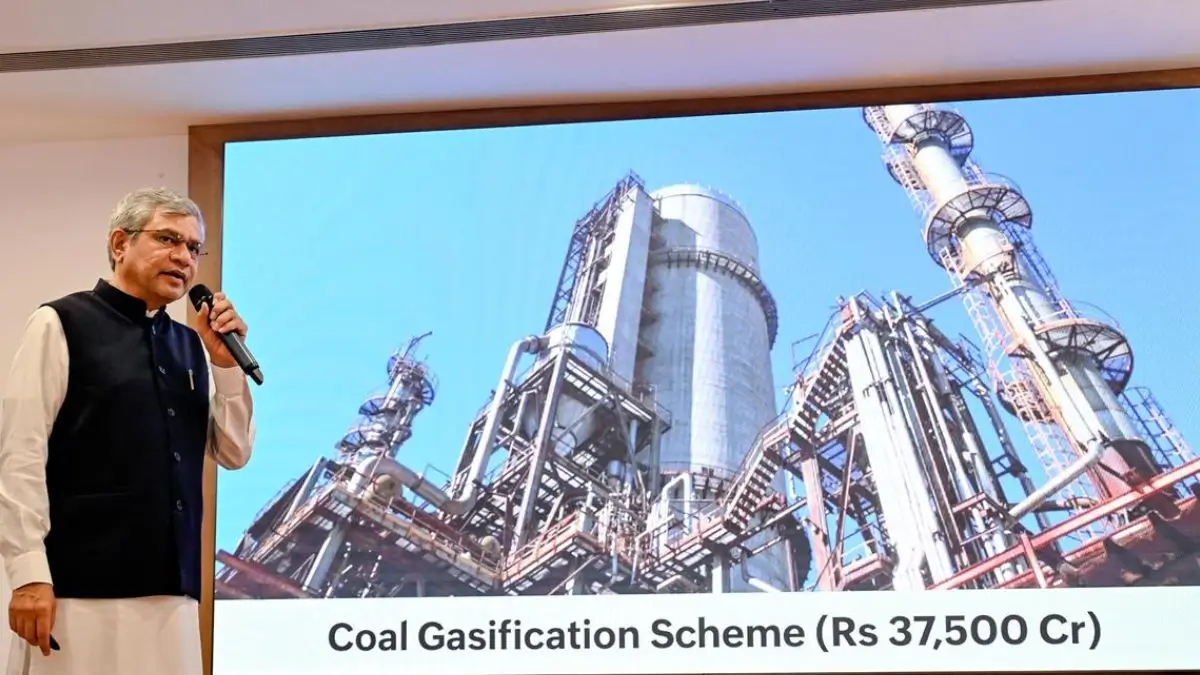
To strengthen the country’s energy future Union Cabinet chaired by Honorable PM Narendra Modi has approved the ₹37,500 crore scheme to promote surface coal and lignite gasification projects. The move aims to reduce the India’s heavy dependence on imported fuels and industrial chemicals and make the better use of domestic coal reserves.
Cabinet Approves ₹37,500 Crore Coal Gasification Scheme
The Union Cabinet chaired by Prime Minister Narendra Modi has approved the major incentive scheme to promote the surface coal and lignite gasification projects across India.
Total financial outlay for the scheme around ₹37,500 crore and it targets the gasification of nearly 75 million tonnes of coal and lignite.
This move supports the India’s broader target of achieving 100 million tonnes of coal gasification by 2030.
The government has designed this scheme to encourage the industrial investment in producing syngas (synthesis gas) and downstream the products like,
- Methanol
- Ammonia
- Urea
- Synthetic Natural Gas (SNG)
- Ammonium nitrate
- Industrial chemicals
What Is Coal Gasification
Coal gasification is a process where coal or lignite is converted into the synthetic gas which is commonly called as syngas.
Instead of directly burning the coal, this process transforms it into the gas mixture mainly containing,
- Hydrogen
- Carbon monoxide
- Small amounts of carbon dioxide and methane
This syngas becomes valuable raw material for making the fuels, fertilizers and chemicals.
Why is this important?
Currently, India imports the large amount of critical industrial products from abroad,
- More than 50% of LNG
- Around 20% of urea
- Nearly 100% of ammonia
- Around 80-90% of methanol
By reducing these imports can significantly improve the India’s trade balance and energy independence.
Why India Is Taking This Step Now
The timing is strategic.
India’s import bill for the key energy and chemical products reached approximately to ₹2.77 lakh crore in FY2025.
Also global geopolitical tensions and specially in West Asia have exposed vulnerabilities in the international supply chains.
As India holding one of the world’s largest coal reserves,
- 401 billion tonnes of coal
- 47 billion tonnes of lignite
the government sees an opportunity to convert the domestic resources into high value industrial products instead of relying heavily on imports.
This project also aligns with broader economic initiatives such as,
- Atmanirbhar Bharat
- Make in India
Key Features of the New Scheme
The scheme includes the several major incentive measures.
The government will provide the financial incentives of up to 20% of plant and machinery cost.
However this limits applies with following structure.
- Maximum ₹5,000 crore per project
- Maximum ₹9,000 crore for a single product category (except Urea and Synthetic Natural Gas)
- Maximum ₹12,000 crore for a single corporate group
Payment Structure
Also the incentives will be released in the four equal instalments which directly links to project milestones.
Also the project will selected through the transparent competitive bidding.
30 Year Coal Linkage Support
A major accompanying reform is the extension of the coal linkage tenure up to 30 years.
This applies under the ‘Production of Syngas leading to Coal Gasification’ sub-sector in the Non Regulated Sector linkage auction framework.
This long term policy certainty is crucial because industrial gasification projects requires the massive capital investments and long payback periods.
Earlier Coal Gasification Efforts
This is not the country’s first move in coal gasification.
- National Coal Gasification Mission was launched in the year 2021.
- Also additionally ₹8,500 crore scheme approved in January 2024.
- Currently, 8 projects worth ₹6,233 crore already under implementation.







 India’s Internet Subscribers Cross 1.1...
 JOSH Campaign Launched to Support Indiaâ...
 PM GatiShakti Completes Five Years: Obje...