
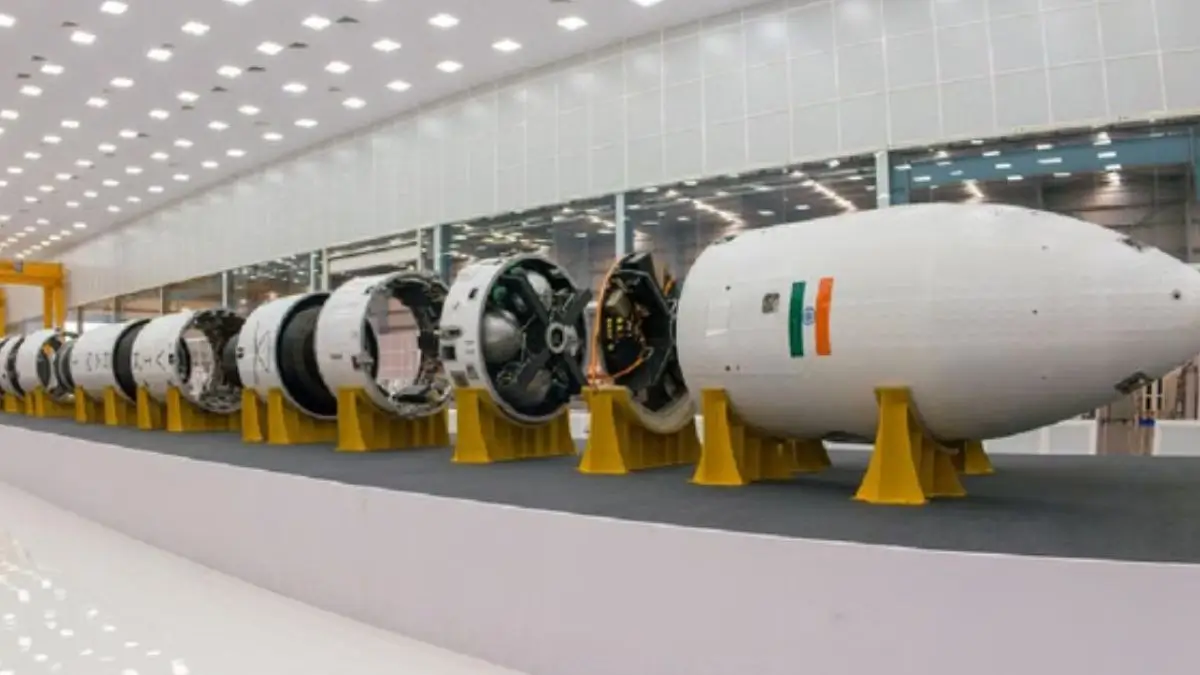
Vikram-1, it is the country’s first ever private orbital rocket developed and designed indigenously. As part of ‘Mission Aagaman’ scheduled for 18 July 2026 from the Satish Dhawan Space Centre (SDSC-SHAR), Sriharikota, this rocket will mark the new milestone for India’s private space sector. In case of a successful launch, Vikram-1 will become the first privately made launch vehicle to launch from an Indian launchpad, establishing the capabilities of the private sector in this sector.
What is Vikram-1?
The Vikram-1 is a launch vehicle developed by private Armor publicly owned Indian Skyroot Aerospace Company, which is among the first and only companies to develop a flight vehicle capable of launching small payloads into low earth orbit (LEO).
The mission will provide vital flight information to facilitate the commercial launches of Skyroot and set a pace of satellite flight missions over the years to come.
Dubbed “Mission Aagaman” meaning that “arrival,” the flight is the first of its kind in Indian private aerospace industry.
What makes the Vikram-1 launch a remarkable one?
There are a number of factors which make the Vikram-1 mission an important one,
- It is the first rocket designed and developed by a private firm attempting to launch from India.
- It is a turning point in the development of the private space ecosystem in India after the recent evolution of the space sector.
- The mission signifies an important achievement toward India’s self-dependence in technologies related to the space business.
- The launch will help India to reinforce its position in the rapidly growing global market of small satellite launches.
- It opens new commercial opportunities for launching services.
The launch comes after Skyroot’s successful suborbital launch of Vikram-S rocket in November 2022, which was the first private rocket to reach outer space from Indian territory.
Plan for Launch and Objectives of Mission
The launch of Vikram-1 is planned for the,
Launch day
- 18 July 2026 (Saturday)
Launch place
- First Launch Pad, Satish Dhawan Space Centre (SDSC-SHAR), Sriharikota
The authorities have given proper notice to the airspace and marine authorities to make necessary restrictions in the zones during the ascent and impact distance of the rocket.
The primary objective of the mission is to do that of testing the functioning of the rocket in live stage in flight and validating its systems for conducting future operational missions.
Technical Characteristics of Vikram-1
Vikram-1 is portrayed as a modern and lightweight launch vehicle that is specially developed for small satellite launches.
Key Characteristics
- Type of Rocket: Multi-stage orbital launch vehicle
- Height: Approx. equal to height of seven stories building
- Payload: 350 kg upper limit
- Orbit: 450 km LEO
- Inclination: 60 degree
- Structure: All-carbon composite
- Propulsion: Self-propelled system
- Engines: 3D-printed engines
- Booster: Solid high-thrust rocket booster
The unique use of the carbon composites reduces the weight and increases strength, making the rocket more efficient for commercial launch missions.
Payloads on Mission Aagaman
Vikram-1 will perform the several technology demonstration tests and at the same time carry out successive payloads from Indian and foreign institutions.
Partners include,
- Grahaa Space,
- Cosmoserve,
- DCubed,
- Skyroot’s SCOPE payload.
Among other payloads is
- Cosmic Bloom, a piece of art created by the Cosmos Diamonds.
- A micro-art payload dedicated to creative innovations targeted only for the outer space missions.
All of these payloads will not only perform technology tests but will also showcase a growing diversity in commercial applications of space.
Mission Aagaman: Building on Vikram-S Success
Mission Aagaman is the second significant mission of Skyroot Aerospace.
Its first mission, Vikram-S, had launched on 18 November 2022 successfully reaching space to become the first ever privately developed rocket of India to cover sub-orbital flight.
The lessons learned from the Vikram-S helped Skyroot’s engineering team to innovate and advance the technologies used, improve the propulsion system, and work on the much superior Vikram-1.
As per the company, the present mission is the result of almost three thousand days of engineering work, contributions from nearly a thousand professionals, and assistance from about four hundred suppliers.








 Elon Musk to Rename SpaceXAI as SpaceXSI
 Kerala Develops AI-Based Dengue Early Wa...
 SpaceX Starship Reaches Orbit for First ...










