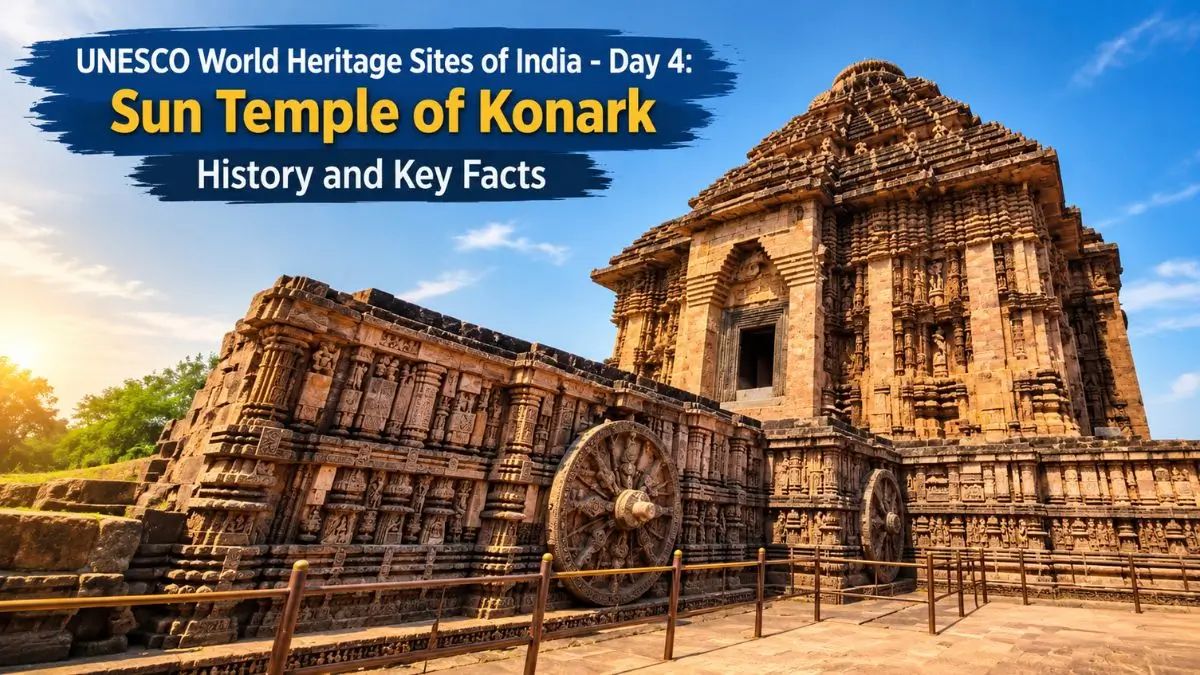
The Konark Sun Temple is one of the greatest masterpieces of medieval temple architecture in India. It was constructed in the 13th century by the Eastern Ganga dynasty as a gigantic chariot drawn by a team of horses for the worship and adoration of Surya, the Hindu Sun God. The artistic excellence of the Kalinga school, therefore, is demonstrated in this structure with its magnificent 24 carved wheels and the elaborate sculptures decorating the chariot’s surfaces; unlike no other monument. In 1984, UNESCO firmly recognized the artistic achievement of superlative measure and its historical linkage to the worship of Surya.
Where Is the Sun Temple of Konark Located?
Konark Sun Temple can be found in Konark in Puri district under the state of Odisha, close to the Bay of Bengal. The word Konark stands for the combination of Arka, meaning the Sun and Kona, meaning the point or corner, respectively.
The Konark Sun Temple is dedicated to the god Surya and is a representation of the Sun God’s chariot in heaven. It is represented as a giant stone structure in India and is one of the famous World Heritage Sites of UNESCO.
The site of the temple extends to an area of 10.62 acres.
Key Points About Konark Sun Temple:
| Feature | Details |
| Location | Konark, Puri district, Odisha |
| God | Surya, the Sun God |
| Era | 13th Century A.D |
| Dynasty | Eastern Ganga Dynasty |
| Builder | King Narasimhadeva I |
| Architecture | Kalinga Style |
| Unique feature | Stone chariot |
| Wheel number | 24 |
| UNESCO admission year | 1984 |
| UNESCO standards | (i),(iii) and(vi) |
| Area | 10.62 hectares |
| Responsible authority | Archaeological Survey of India. |
History of the Konark Sun Temple
Construction of the Temple
- The Konark Sun Temple is believed to have been established during the reign of King Narasimhadeva I (1238–1264 CE) of the Eastern Ganga dynasty. Its completion magnificently shows the political power, spiritual traditions, and artistry of the then Odisha kingdom in the 13th century.
- The construction of the temple was unparalleled in size and ornamental artistry. The stone carving of the temple contains statues of deities and idols of musicians, dancers, animals, and different moments from daily life in the temple.
- The building has a rich tradition of storytelling referring to the architect of the building and his assistants.
What Caused the Partial Ruin of the Temple?
- The main sanctuary, referred to as the vimana, consisted of a tall building topped with a shikhara. However, this tower was already missing by the 19th century.
- At present, the structures that still exist include the audience halls, sculptures, and other buildings that testify to the grandeur of the original architecture.
- The existing monument continues to suffer from deterioration because of its environmental exposure, weathering, and damage to the stone constructions and carvings.
The Architecture of Konark Sun Temple
The Konark Sun Temple is considered to be the peak of Kalinga school of temple architecture, which is the name for the local architecture that originated in the state of Odisha. Its architectural design is characterized by monumental dimensions, rich stone decorations, and well-considered arrangement of spaces.
The Surya’s Chariot
- The most significant element of the temple is the representation of Surya’s chariot. There are 12 pairs of wheels, making 24, with elaborate and artistic designs. UNESCO interprets these motifs as representing the different phases of the months and seasons.
- The wheel has a diameter of about three meters, and the spokes and the decorative elements reflects the creative abilities of the artists. The chariot image reflects the solar deity’s movement across the sky and the link between architecture and religious cosmology.
UNESCO’s description says the chariot is pulled by seven horses, while a shorter synonym says there are six.
Key Architectural Features
| Feature | Explanation |
| Vimana | The main sanctum, where the lofty structure above has not survived. |
| Jagamohana | The hall for audiences, which continues to be a prominent architectural element of the temple complex. |
| Natamandira | The dancing hall, placed on a high platform, but now roofless. |
| Stone wheels | Carvings forming the chariot motif in stone. |
| Sculptural reliefs | Motifs of various gods, animals, dancers, musicians, and people of the period. |
The sculptures on the temple are not just religious representations. They offer a glimpse of the socio-cultural life of medieval Odisha.
Why is the Konark Sun Temple a UNESCO World Heritage Site?
Konark Sun Temple was designated as a UNESCO World Heritage Site in 1984 based on three cultural criteria: (i), (iii), and (vi).
| UNESCO criterion | Relevance |
| Criterion (i) | It recognizes the temple as a unique artistic creation with regard to conception, architecture, and sculptural work. |
| Criterion (iii) | Considered to be an exceptional testimony to the civilization of the 13th-century kingdom of Odisha. |
| Criterion (vi) | Its association with Surya and his worshippers. |
The monument is a protected structure under the Ancient Monuments and Archaeological Sites and Remains Act, 1958, India.








 UNESCO World Heritage Sites of India - D...
 Siang Upper Multipurpose Project: Why Ar...
 Who Named Cyclone Arnab? Meaning and How...