
When most people hear the term “central bank,” they think about interest rates, inflation, or maybe currency notes. But central banks quietly shape almost every part of an economy — from the price of your education loan to the stability of your savings account.
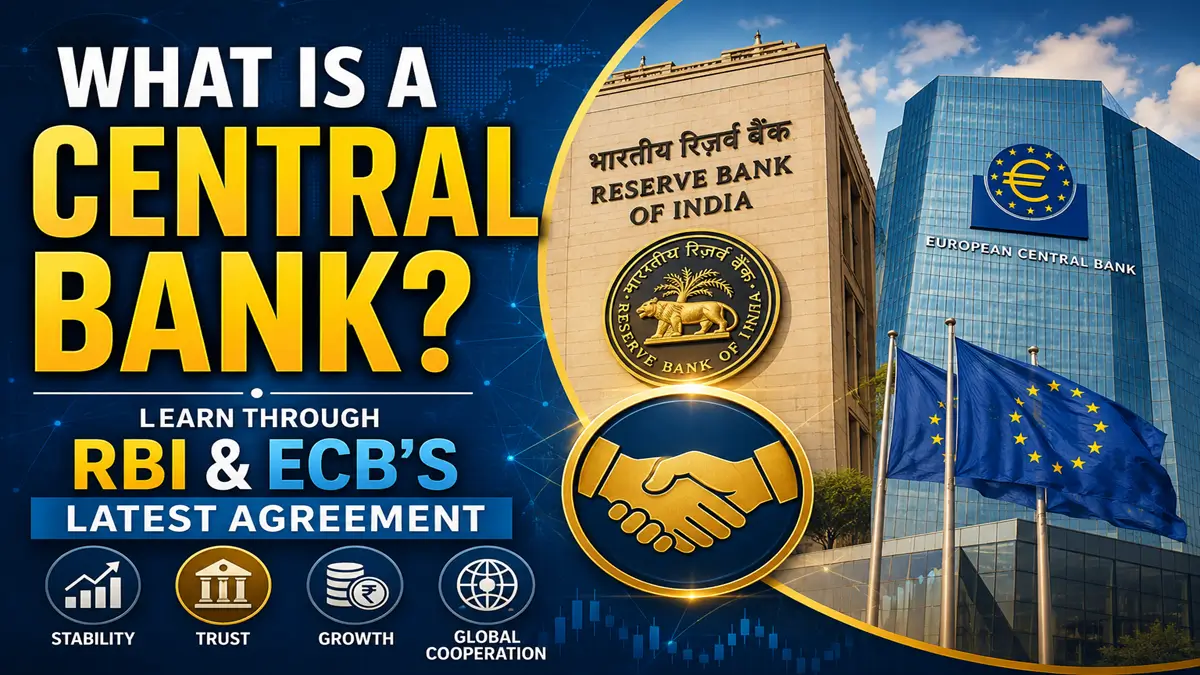
Recently, the Reserve Bank of India and the European Central Bank strengthened their cooperation through a revised agreement focused on information exchange and central banking collaboration. While the news sounded technical, it actually offers a great way to understand what central banks really do and why global cooperation matters today.
This article explains central banking in a simple, human way — without textbook language.
Why Central Banks Exist in the First Place
Imagine a country without a financial referee.
Banks could fail without warning. Inflation could rise uncontrollably. Currency value could swing wildly. Loan rates could become unpredictable. Governments might print excessive money during economic pressure.
A central bank exists to prevent that chaos.
A central bank is the main financial institution responsible for managing a country’s money system, banking stability, and economic balance.
For India, that institution is the Reserve Bank of India.
For Europe’s euro-using nations, it is the European Central Bank.
What Does a Central Bank Actually Do?
Most people think central banks only “increase or decrease interest rates.” In reality, their responsibilities are much larger.
1. Controlling Inflation
Inflation affects daily life directly.
If food, fuel, education, and housing prices rise too quickly, people lose purchasing power. Central banks try to keep inflation under control using monetary policy.
For example:
- If inflation becomes too high, the RBI may increase repo rates.
- Higher borrowing costs reduce spending.
- Lower spending can slow price increases.
This balancing act is one of the toughest jobs in economics.
2. Protecting the Banking System
Commercial banks handle public money. If banking systems collapse, economies suffer.
Central banks monitor:
- Liquidity
- Banking risks
- Financial fraud trends
- Systemic stress
- Digital payment security
During financial crises, central banks often become the “lender of last resort” to support struggling financial institutions.
3. Managing Currency Stability
Central banks regulate money supply and support confidence in national currencies.
The RBI manages the Indian Rupee.
The ECB manages the Euro used across multiple European nations.
A stable currency helps:
- International trade
- Foreign investment
- Economic confidence
- Import-export balance
4. Supporting Economic Growth
Central banks do not directly create jobs, but their decisions influence:
- Business expansion
- Startup funding
- Housing demand
- Consumer spending
- Investment activity
Low interest rates usually encourage borrowing and economic growth. Higher rates generally slow economies to control inflation.
Why the RBI–ECB Agreement Matters
The latest agreement between the Reserve Bank of India and the European Central Bank is important because modern economies are deeply connected.
Financial crises no longer stay inside one country.
A banking issue in Europe can affect:
- Indian exports
- Currency markets
- Foreign investments
- Stock markets
- Technology funding
That is why central banks increasingly cooperate internationally.
The revised agreement focuses on:
- Sharing financial information
- Cooperation in central banking practices
- Better understanding of economic risks
- Stronger institutional coordination
In simple terms, it helps both sides prepare for global financial uncertainty more effectively.
The Hidden Role of Central Banks in Everyday Life
Many people do not realize how frequently central banks affect ordinary routines.
Your life is influenced by central banking when:
- Your home loan EMI changes
- Fixed deposit interest rates rise or fall
- Petrol prices affect inflation
- Startup funding becomes expensive
- Stock markets react to policy announcements
- Currency exchange rates fluctuate
Even online payment systems and digital banking security are connected to central bank oversight.
Central banking is not distant economics — it is deeply connected to household life.
Why Central Banks Are Becoming More Important in 2026
The global economy is changing rapidly.
Central banks are now dealing with:
- AI-driven financial systems
- Digital currencies
- Cybersecurity threats
- Cross-border payment systems
- Climate-related financial risks
- Cryptocurrency regulation
- Global inflation shocks
Traditional banking supervision is no longer enough.
The cooperation between institutions like the RBI and ECB shows how financial governance is becoming more global and technology-focused.
RBI vs ECB: One Big Difference
The Reserve Bank of India controls monetary policy for one country — India.
The European Central Bank manages policy for multiple European economies using the Euro.
That makes the ECB uniquely complex.
It must balance economic conditions across countries with different:
- Growth rates
- Debt levels
- Inflation trends
- Employment conditions
Meanwhile, the RBI focuses entirely on India’s economic priorities.








 NPCI Defers 0.4% MDR on Select UPI Trans...
 SEBI Credit Risk-o-Meter for Bonds: Six ...
 RBI Raises Daily CRR Maintenance Require...










