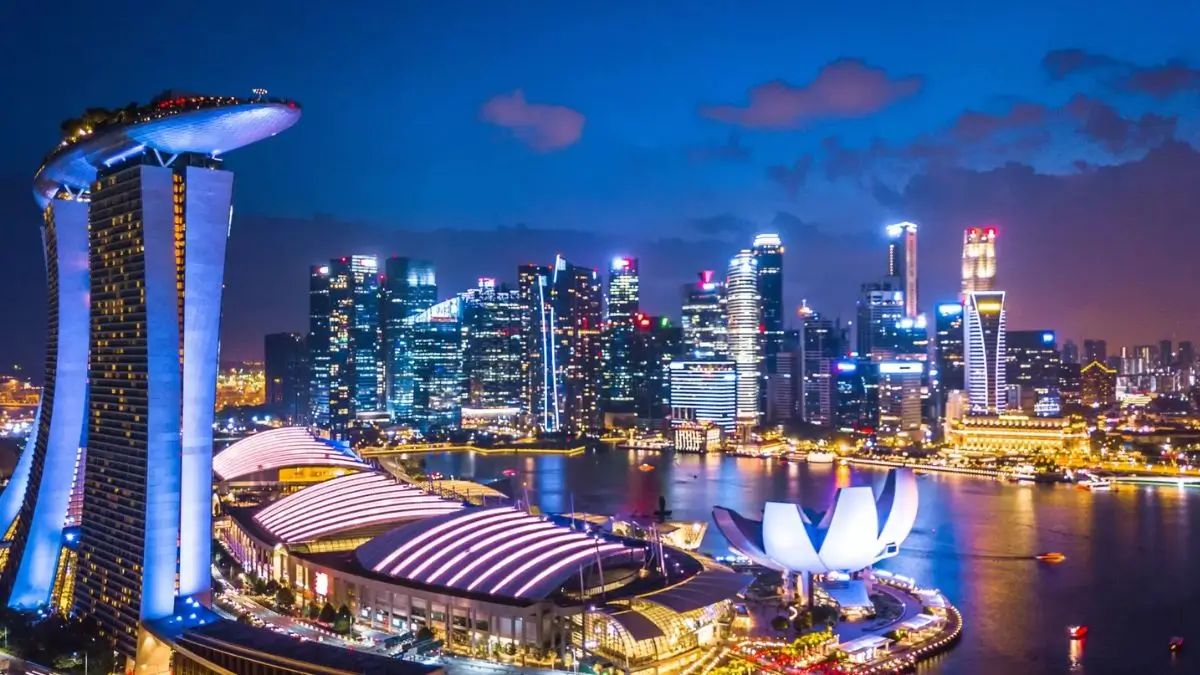
Can you imagine a place where the city and the country are exactly the same. There is no separate capital, no provinces and no distant regions to govern. While most of the nations consist of the hundreds of cities and towns, but there is one remarkable place in Asia breaks all the conventional rules.
That place is the Singapore, it is a unique island nation which functions simultaneously as the city, a country and its own capital.
Despite the its small size, Singapore has become world’s one of the most prosperous economies and it is a global hub for trade, finance, technology, and innovation.
Singapore: The Only City-State in the Asia
It is located in the Southeast Asia, which is approximately 137 kilometers (85 miles) north of the equator, Singapore is one of the few modern city-states in the existence.
Unlike countries such as the Japan, India, or China, Singapore does not have any separate capital city.
The entire nation functions as the single urban area which making it both as city and an independent sovereign country.
This unique structure means that the national government oversees everything from the local neighborhood development and transportation systems to foreign policy and international relations.
Why Is Singapore Both a City and a Country?
Singapore’s status as the city-state which makes it different from nearly every other country in the world.
No Separate Capital City
Most nations have the designated capital that serves as the administrative center. In the Singapore’s case, there is no distinction between the capital and the country itself. Singapore is both.
Unified Governance
The parliament and government manage all the national and municipal affairs under one administrative framework in the country. This streamlined system allows for the efficient planning and decision-making.
One Main Island and Many Smaller Islands
Although it is often viewed as the single urban center, Singapore consists of the one main island known as Pulau Ujong and it is more than to 60 smaller surrounding islands. Together, they forms the Republic of Singapore.
Key Facts About Singapore
Singapore may be small in the size, but it ranks among the world’s most developed nations.
- Official Name: Republic of Singapore
- Total Area: It is approximately 710 square kilometers, with land area gradually expanding through the land reclamation projects.
- Population: Around 5.9 million people.
- Independence Day of Singapore: August 9, 1965.
- Government System: Unitary Westminster-style Parliamentary Republic.
Despite the its limited land area, Singapore has developed the world-class infrastructure, efficient public transportation, modern healthcare and a highly competitive economy.
How Did Singapore Become a City-State?
Singapore’s journey to the independence is one of the most remarkable stories in the modern history.
During the 19th century, it emerged as the important British trading post due to its strategic location along major maritime routes.
Over a period of time, it became as Asia’s one of the busiest commercial centers.
After the World War II, Singapore moved towards the self-governance and later joined the Federation of the Malaysia in 1963.
However, due to the political and economic differences led to an unexpected separation. On August 9, 1965, Singapore has officially became an independent nation.
From Resource-Poor Island to Global Economic Powerhouse
Without oil, large mineral reserves or vast agricultural land, Singapore has focused on those sectors where it could compete globally.
The government invested heavily in the,
- International trade
- Financial services
- Education
- Technology
- Infrastructure
- Port development
Over the last couple of decades, these investments has helped the Singapore to become one of the world’s leading business and financial centers.
Today, its port ranks among the busiest in the world, while its airport, public transport system and urban planning are frequently cited as the models for other countries.
A Model of Urban Planning and Innovation
One of Singapore’s most impressive achievements is the its ability to balance rapid urban development with the environmental sustainability.
Despite it is densely populated, the city-state is known for the its extensive green spaces, urban gardens and carefully planned infrastructure.
This approach has also earned it the nickname as “The Garden City.”
As the modern skyscrapers stand alongside parks, nature reserves and waterfront attractions creating the unique blend of the urbanization and environmental preservation.








 Guava Capital of India: Which Place Is K...
 7 Most Beautiful Train Stations in the W...
 World Architecture Day 2026: 8 Clever Fe...