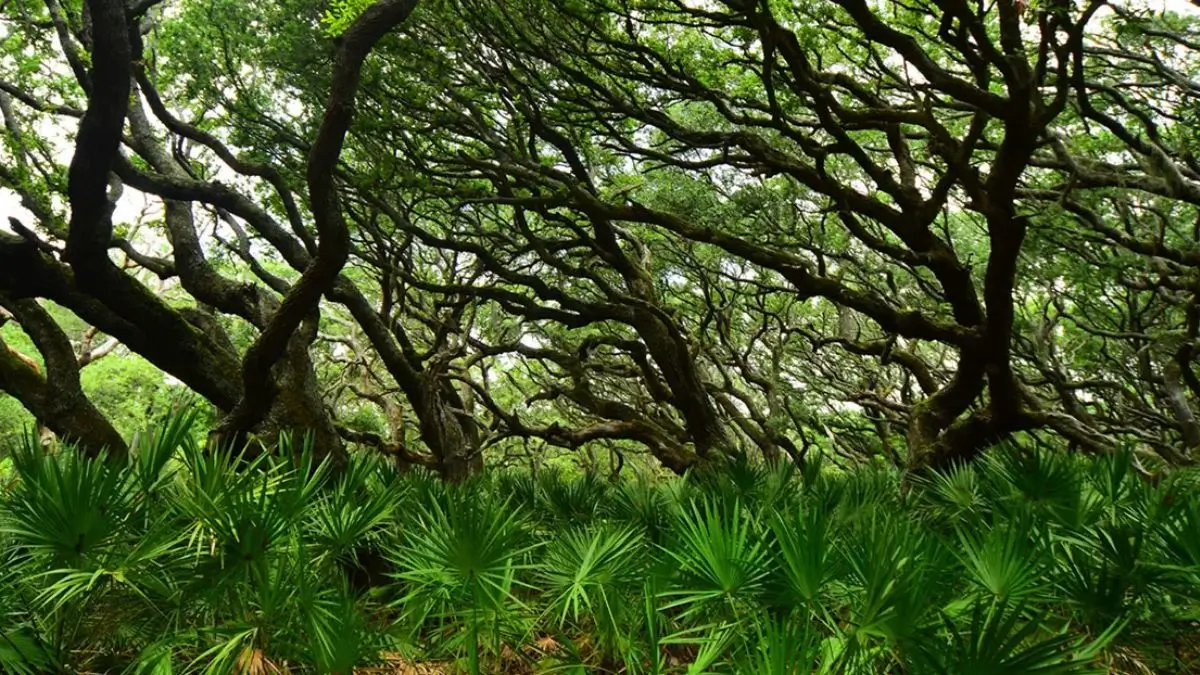
Imagine you are walking through a crowded city that filled with traffic, concrete buildings and pollution and you suddenly finding yourself surrounded by a dense green forest buzzing with the birds and insects. This is the idea behind the Miyawaki forest technique that is a revolutionary method of creating dense forests in the small urban spaces.
It was originally developed in Japan, the Miyawaki method has become one of the most popular urban afforestation techniques in the India. From Bengaluru and Mumbai to Delhi and Hyderabad, most cities are adopting this model to improve the biodiversity, reduce pollution and to combat rising urban temperatures.
The growing popularity of the Miyawaki forests has transformed the vacant urban land into the thriving ecosystems within just a few years.
What Is a Miyawaki Forest?
A Miyawaki forest is the dense, multi-layered forest created by planting a large number of the native tree species close together. This technique mimics the natural forest ecosystems and it allows trees to grow much faster than conventional plantations.
Unlike the traditional plantations which often contain a limited number of species, Miyawaki forests includes the diverse mix of native plants.
Trees, shrubs and smaller vegetation are planted in the multiple layers and it creates the self-sustaining ecosystem.
The method can produce the forest that grows nearly ten times faster and it becomes significantly denser than conventional plantations. Once it fully established, these forests generally require the minimal maintenance after the first few years.
Who Invented the Miyawaki Forest Method?
The Miyawaki method was developed by the Japanese botanist and ecologist Akira Miyawaki.
During his research on the natural vegetation in Japan, Dr. Miyawaki has observed that the native forests near ancient temples and shrines were more resilient and biologically diverse than commercial plantations.
Based on these observations, he developed the scientific afforestation technique in the 1970s that focused on to the restoring native ecosystems.
His contribution to the ecological restoration had earned him the international recognition which includes the prestigious Blue Planet Prize in 2006.
What Is the Miyawaki Forest Project in India?
The Miyawaki Forest Project in India refers to the large-scale adoption of the Miyawaki technique bythe multiple government agencies, municipal corporations, environmental organizations and private companies.
The objective is to create the dense forests in urban and semi-urban areas where land availability is limited. These forests are developed in the parks, school campuses, industrial areas, roadside spaces and residential colonies.
Major Indian cities such as Ahmedabad, Mumbai, Delhi, Bengaluru, Chennai and Hyderabad have implemented the Miyawaki forest projects to improve air quality and increase the green cover.
Several urban local bodies have also integrated the technique into climate-resilience and sustainability programs.
Who Started Miyawaki Forests in India?
The first Miyawaki forest in India was developed in the year 2009 near Bidadi, Karnataka around a manufacturing facility operated by Toyota.
This project was created with technical guidance from Dr. Akira Miyawaki himself. Later, environmental entrepreneur Shubhendu Sharma played the crucial role in popularizing the technique across India.
After working on the initial project, Sharma has founded the Afforestt in 2011 and helping to adapt the Miyawaki method to Indian climatic and soil conditions. Since then, hundreds of the Miyawaki forests have been established throughout the country.
How Does the Miyawaki Technique Work?
The Miyawaki method follows the scientific process,
First, local native species are identified based on the regional ecology. The soil is then enriched with the organic materials to improve fertility and water retention.
Trees are planted very closely, usually three to five saplings per square meter.
This creates the competition for sunlight and encouraging the rapid vertical growth.
A typical Miyawaki forest consists of the four vegetation layers which includes,
- Shrub Layer
- Sub-Tree Layer
- Tree Layer
- Canopy Layer
This layered structure closely resembles the natural forest ecosystem and it enhances biodiversity.
Largest Miyawaki Forest in the World
One of the world’s largest Miyawaki forest projects is located at the Smritivan Earthquake Memorial and Museum in Gujarat.
It spread across more than 470 acres on Bhujiyo Hill and this project was developed as a memorial to the victims of the 2001 Gujarat earthquake.
It demonstrates that the Miyawaki technique can be successfully implemented on a much larger scale beyond the small urban spaces.
This project combines the ecological restoration with the environmental conservation and public awareness.
Minimum Area Required for a Miyawaki Forest
One of the major advantages of the Miyawaki method is its flexibility.
A functional Miyawaki forest can be developed in an area which as small as 100 square metres. In some urban settings, even smaller plots of 30–50 square metres have been used successfully.
This makes the technique suitable for the,
- Schools
- Housing societies
- Industrial campuses
- Government offices
- Community parks
The area should ideally receive sufficient sunlight and have adequate soil depth for root growth.
Benefits of Miyawaki Forests
Miyawaki forests offers the several environmental and social benefits.
They improve the air quality by absorbing pollutants and carbon dioxide. Dense vegetation also helps to lower the surrounding temperatures and reduce the urban heat island effect.
These forests also supports the biodiversity by attracting birds, butterflies, insects and other wildlife. Their deep root systems improves the groundwater recharge and help reduce soil erosion.
In addition, the Miyawaki forests creates the green recreational spaces and enhance the aesthetic value of urban areas.








 UNESCO World Heritage Sites of India - D...
 Jamnagar Refinery: Why India's Oil Hub M...
 UNESCO World Heritage Sites of India - D...