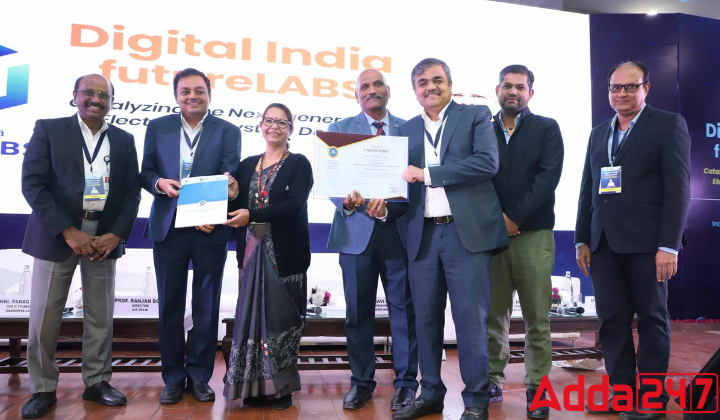
In a development for indigenous manufacturing and innovation, Prama India has forged a partnership with the Government of India’s Centre for Development of Advanced Computing (C-DAC). This collaboration, facilitated through a Transfer of Technology (ToT) agreement, focuses on the production, marketing, and support of Thermal Cameras.
Empowering Indigenous Manufacturing and Innovation
- Prama India’s collaboration with C-DAC, under the Ministry of Electronics & Information Technology (MeitY), underscores India’s commitment to Atmanirbhar Bharat.
- The partnership aligns with the vision of Viksit Bharat and Surakshit Bharat, contributing to the nation’s self-reliance and security objectives.
Official Announcement at Digital India FutureLabs Summit
- The partnership was officially unveiled during the Digital India FutureLabs Summit, an event showcasing India’s strides in next-generation electronics.
- Rajeev Chandrasekhar, Minister of State for MeitY, highlighted the significance of such collaborations in fostering indigenous manufacturing and innovation.
Driving Innovation through Research and Development
- The collaboration between Prama India and C-DAC signifies a leap in research and development (R&D) efforts, leveraging technologies to develop next-generation Thermal Cameras.
- This initiative is aligned with the Digital India Programme’s goal of propelling India towards global leadership in electronics system design and manufacturing (ESDM).
Understanding Thermographic Cameras
- A thermographic camera, also known as an infrared camera or thermal imaging camera, operates by capturing images through infrared radiation, unlike standard cameras that use visible light.
- While a typical camera captures light in the 400–700 nanometer range, infrared cameras detect wavelengths ranging from approximately 1,000 nm (1 micrometer or μm) to around 14,000 nm (14 μm). The process of capturing and analyzing the data produced by these cameras is known as thermography.
Transforming India’s Electronics Landscape
- Prama India’s commitment to indigenous manufacturing echoes the ethos of ‘Made for India, Made by India, Made in India.’
- By manufacturing Thermal Cameras tailored to Indian security needs, Prama India contributes to the nation’s journey towards self-sufficiency in technology.
- By focusing on innovation, collaboration, and indigenous manufacturing, India is poised to lead the global electronics industry into the future.








 What RBI’s New Partnership with I4C Me...
 IndiaAI and ICMR Sign MoU to Strengthen ...
 India Partners with UNDP and Global Envi...