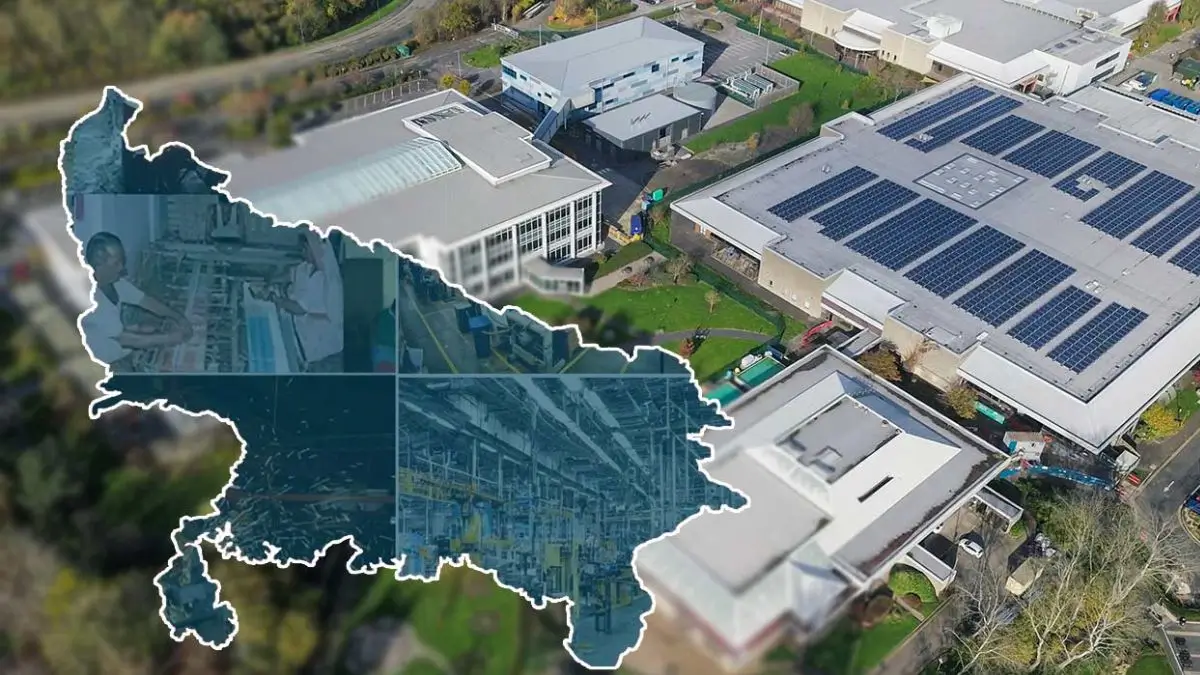
Uttar Pradesh Private Business Park Development Scheme, 2025 is an important scheme that has been designed by the State of Government of Uttar Pradesh for establishing the world class Plug & Play Business Parks by using the Public Private Partnership (PPP).
This policy mainly focuses on the development of world-class business parks via the PPP mode with the objective of to attracting Global Capability Centres (GCCs), IT Companies, technology companies, research organizations, and other knowledge-based industries. The scheme will provide a pre-developed infrastructure facility for setting up industries on government land.
What is UP Private Business Park Development Scheme, 2025?
This scheme was introduced on 24th March 2026, and it offers guidelines to develop integrated business parks via private development but with government ownership of the land.
Instead of the usual industrial parks where manufacturing is the core business, these business parks offer spaces to IT, ITeS, GCCs, BPOs, R&D, AI, fintech, and other such industries.
In this scheme, the private developer will have to bear all costs and operations of the project until its completion and transfer it back to the government after the concession period ends.
Why Was the Scheme Launched?
The scheme was launched by the government of Uttar Pradesh due to the lack of large integrated office ecosystems for technology-based industries. Most companies are affected by delays in land acquisitions, infrastructural developments, and other approvals prior to starting their businesses.
The main purpose of the scheme is to provide companies with an already developed and functioning infrastructure that will significantly reduce the setup time while simultaneously attracting domestic and international investors.
The scheme also helps the state move beyond manufacturing and enter high-value service industry segments and innovation-based industries.
Objectives of the Scheme
The scheme has a few objectives, which include,
- Development of modern business parks which are ready for use.
- Luring multinational companies and Global Capability Centres.
- Development of IT, ITeS, AI, BPO, and research-based industries.
- Private investments on government lands.
- Creation of skilled job opportunities.
- Improvement of digital economy of Uttar Pradesh.
- Promoting innovations and research ecosystems.
- Long-term revenues for government agencies.
Key Features of the UP Private Business Park Development Scheme 2025
Public-Private Partnership (PPP)
- The project utilizes the Design, Build, Finance, Operate and Transfer (DBFOT) approach.
- Although ownership of the government land will remain vested with the government, it is the chosen developer that will finance, construct, operate, maintain, and commercially manage the business park.
Minimum Area of Government Land
- Every business park shall be built using a minimum area of 10 acres of government land.
- The office facilities being vertically developed, the minimum area required is relatively smaller compared to industrial parks.
45-Year Concession Period
- Developers are granted the right to operate and commercially manage the business park for 45 years.
- There are possibilities for extending the period of operation according to the terms of the concession agreement.
- At the end of the concession period, the developed property will revert back to the government.
Development Timetable
In order to ensure that the work is done promptly, the policy outlines phased development objectives.
Typically, projects are required to develop initial phases within two years and complete the development within three years.
Development of large projects may occur in phased manner depending on feasibility and approvals.
Requirement of Anchor Tenant
One of the unique aspects of the scheme is the requirement of obtaining anchor tenants.
Developers will be required to get Letter of Intent (LoI) or any other form of commitment from at least two Fortune Global 500 firms, Fortune India 500 firms or multinationals having coverage of at least 20% of total leasable area of the park.
This provision guarantees the demand for commercial space in the park.
Eligibility Conditions
Eligible applicants include,
- Private real estate developers
- Companies involved in infrastructure development
- Publicly listed firms
- Real Estate Investment Trusts (REITs)
- Consortium comprising of qualified firms
Illustrative eligibility criteria include.
- Minimum net worth of ₹1,000 crore
- Average annual turnover of ₹500 crore in the last three financial years
- Minimum of seven years of experience
- Experience in commercial real estate, project development, leasing & facility management
For consortia, the leading firm should have at least 51% equity interest.
Financial Model
Rather than offering any subsidy directly, the program provides developers business opportunities to develop commercial parks.
Key financial terms include,
- Minimum upfront land premium: 5% of current land valuation
- Revenue sharing: Minimum 7% of rental income
- 45 years of commercial development rights
- Stamp duty waiver (subject to certain criteria)
- Performance based on engineer’s audit
Companies working out of these parks may be eligible for incentives from other Uttar Pradesh sectoral policies like GCC, IT and electronics policies.
Implementation Process
This program is to be carried out via specific project bidding.
Steps in the process are,
- Land selection by the government.
- Feasibility study.
- Request for Proposal (RFP).
- Technical and financial bid.
- Developer selection.
- Development of concession agreement.
- Construction of the facility.
- Leasing of the commercial facilities to the eligible companies.





 Delhi Doubles ASHA Incentives, Launches ...
 Guava Capital of India: Which Place Is K...
 7 Most Beautiful Train Stations in the W...