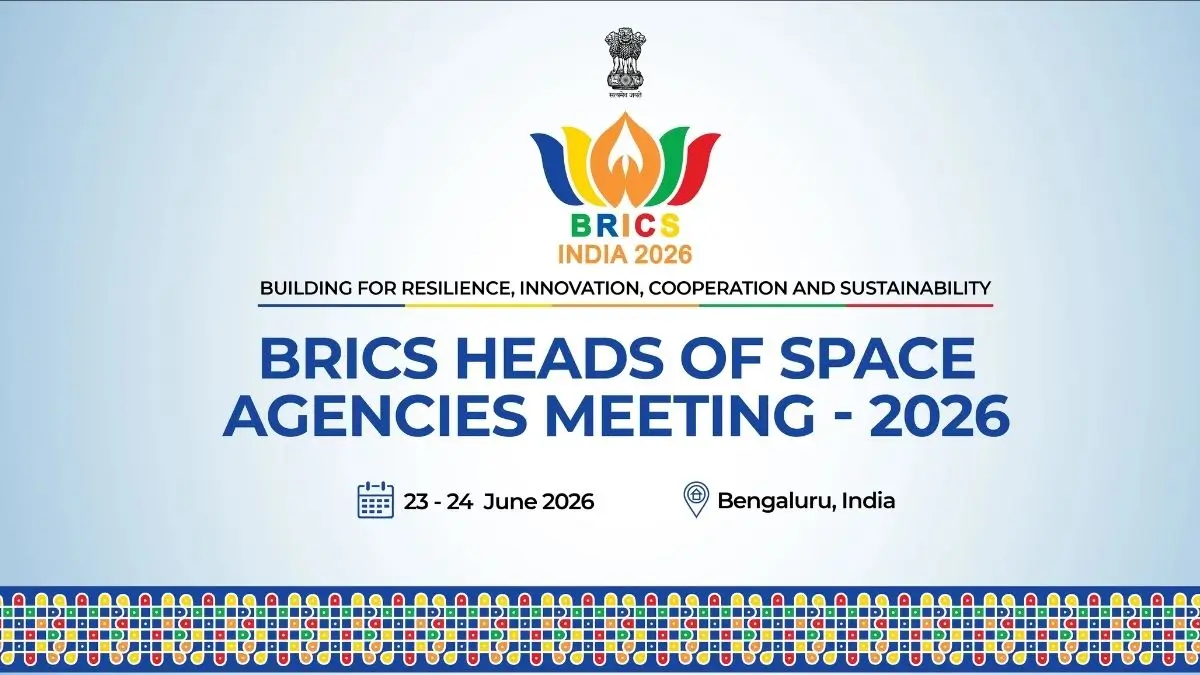
On 23rd to 24th June, 2026 in Bengaluru India hosting the BRICS Heads of Space Agencies (HOSA) Meeting 2026. This meeting brings together the senior representatives and heads of space agencies from all the eleven BRICS member nations. This event showcases the India’s growing influence in the global space diplomacy and also highlights the increasing importance of the cooperation in addressing challenges such as space sustainability, satellite coordination and emerging space technologies.
What Is the BRICS Heads of Space Agencies Meeting?
The BRICS Heads of Space Agencies Meeting is the high-level forum which enables member countries to discuss the cooperation in space exploration, satellite applications, Earth observation and emerging space technologies.
The 2026 edition is being hosted by the Indian Space Research Organization (ISRO) and the Department of Space (DoS), with the support from the Ministry of External Affairs.
This event aligns with the India’s BRICS Chairship theme: “Building for Resilience, Innovation, Cooperation and Sustainability.”
The meeting also showcases the “people-centric” and “humanity-first” approach emphasized by the Honorable Prime Minister Narendra Modi during the BRICS Summit 2025 in the Rio de Janeiro, Brazil.
Which Countries Are Participating?
The meeting brings together the representatives from all eleven BRICS member countries,
- Brazil
- China
- Egypt
- Ethiopia
- India
- Indonesia
- Iran
- Russia
- Saudi Arabia
- South Africa
- United Arab Emirates
Space Sustainability Takes Center Stage
One of the most important themes of this meeting is the space sustainability.
As the number of the satellites in orbit continues to increase, concerns about space debris, orbital congestion and long-term sustainability have becomes the global priorities.
BRICS member agencies are also expected to exchange their views on to the,
- Sustainable space operations
- Space debris mitigation measures
- National governance frameworks
- Regulatory approaches for safe space activities
- Best practices for responsible satellite deployment
Strengthening the BRICS Remote Sensing Satellite Constellation
Another major agenda is the proposed expansion of the BRICS Remote Sensing Satellite Constellation (RSSC).
This RSSC initiative will allows the member countries to share the Earth observation data for applications such as the,
- Disaster management
- Agriculture monitoring
- Climate studies
- Urban planning
- Environmental protection
Proposal for a BRICS Space Council
The Bengaluru meeting will also examine the Terms of Reference for the proposed BRICS Space Council.
If this council established, the council could serve as the permanent mechanism for coordinating space-related activities among BRICS nations.
Potential responsibilities may includes the,
- Policy coordination
- Joint research initiatives
- Capacity building programs
- Technology sharing
- Long-term strategic planning
India’s Growing Role in the Global Space Sector
India’s decision to host the meeting also highlights the its rising stature in the international space community.
Through ISRO, India has built the reputation for the,
- Cost-effective space missions
- Advanced satellite capabilities
- Planetary exploration programs
- Commercial launch services
- Space-based applications for development








 Elon Musk to Rename SpaceXAI as SpaceXSI
 Kerala Develops AI-Based Dengue Early Wa...
 SpaceX Starship Reaches Orbit for First ...