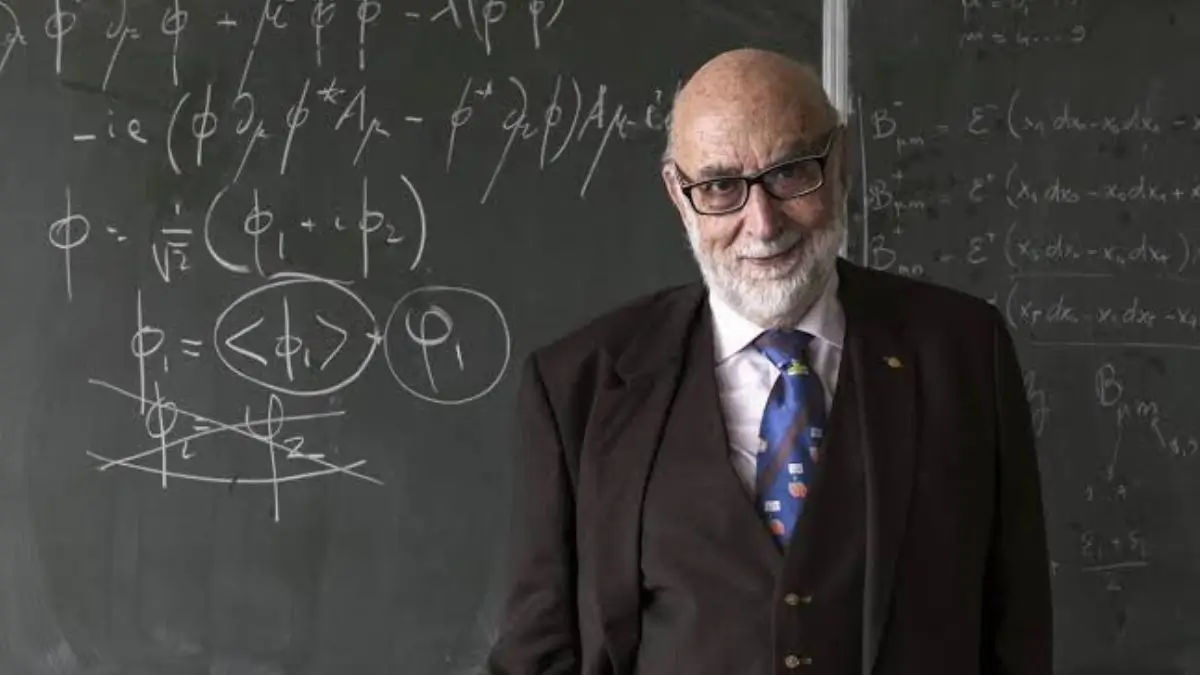
The Belgian theoretical physicist François Englert who discovered the groundbreaking work which had laid the foundation for the discovery of the Higgs boson was passed away on 18th of June at the age of 93. His research has fundamentally changed the understanding of how the particles acquire mass and it helps to shape the Standard Model of the particle physics. His contributions continue to influence the modern scientific research.
Who Was François Englert?
François Englert was born in the Brussels, Belgium, on November 6th 1932. Initially studying the electrical engineering, he later shifted his focus to physics and completed his doctoral studies at the Free University of the Brussels in the year 1959.
After a brief period at the Cornell University in the United States, Englert returned to the Belgium and he spent most of his academic career.
Throughout his career, Englert remained dedicated to understanding the fundamental laws which governing the universe and contributing significantly to the particle physics and quantum field theory.
The Scientific Breakthrough That Changed Physics
During the early 1960s, physicists were struggling to explain how the fundamental particles acquire mass without violating the principles of the gauge symmetry.
Working alongside with the fellow physicist Robert Brout, Englert proposed the revolutionary idea in the year 1964.
Their theory has suggested that particles gain mass through the interactions with an invisible field that exists throughout the universe.
This concept became known as the Brout-Englert-Higgs mechanism.
At the same time, British physicist Peter Higgs also independently arrived at the similar conclusion and he further demonstrated the existence of the new particle which is associated with this field.
That particle later became famous or known as the Higgs boson.
This theory has provided the crucial missing piece in the Standard Model and this framework used to describe the fundamental particles and the forces of nature.
Long Search for the Higgs Boson
After the theoretical prediction, scientists spent nearly the decades to find the experimental evidence for the Higgs boson.
The search became one of the most ambitious scientific projects in the modern history.
Researchers around the world also collaborated to build the increasingly powerful particle accelerators capable of probing the fundamental structure of matter.
This breakthrough finally arrived in the year 2012 when scientists working at CERN’s Large Hadron Collider announced the discovery of the particle consistent with the Higgs boson.
The discovery has confirmed the mechanism proposed by Englert and his colleagues nearly five decades earlier.
Nobel Prize Recognition
In the year 2013, François Englert and Peter Higgs were jointly awarded the Nobel Prize in the Physics.
The Nobel Committee recognized them “for the theoretical discovery of a mechanism that contributes to our understanding of the origin of mass of the subatomic particles.”
Unfortunately, Robert Brout had passed away in the year 2011 and was therefore ineligible for the award, as Nobel Prizes are not awarded posthumously.
The Nobel Prize also cemented the Englert’s place among the most influential scientists of the modern era.
Other Major Honors and Achievements
Apart from the Nobel Prize, Englert received the numerous prestigious awards throughout his career.
His notable recognitions includes the,
- Francqui Prize (1982)
- Wolf Prize in Physics (2004)
- J. J. Sakurai Prize (2010)
- Belgian Barony conferred by King Albert II in 2013








 Veteran Actor Nana Patekar Passes Away a...
 Veteran Filmmaker Singeetham Srinivasa R...
 Renowned British Novelist Jeffrey Archer...