
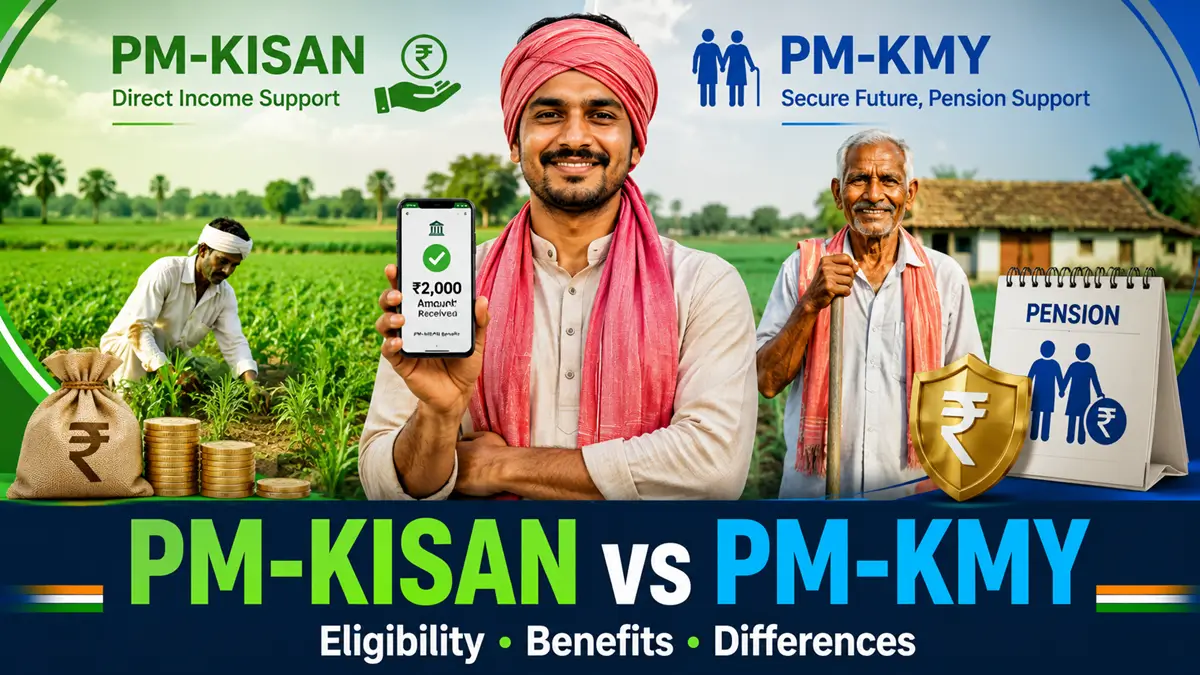
The Government of India has introduced several schemes to provide financial support and social security to farmers. Two important schemes are Pradhan Mantri Kisan Samman Nidhi (PM-KISAN) and Pradhan Mantri Kisan Maan Dhan Yojana (PM-KMY).
Although both schemes are designed for farmers, their objectives and benefits are different. PM-KISAN provides direct income support, while PM-KMY is a contributory pension scheme designed to provide social security after the age of 60 years.
PM-KISAN: Pradhan Mantri Kisan Samman Nidhi
PM-KISAN is a Central Sector Scheme that became operational on 1 December 2018. Under the scheme, eligible landholding farmer families receive ₹6,000 per year through Direct Benefit Transfer (DBT) in three equal instalments of ₹2,000 each.
The scheme is intended to supplement farmers’ financial requirements for agricultural inputs and household needs.
Key Features of PM-KISAN
- Full Name: Pradhan Mantri Kisan Samman Nidhi
- Ministry: Ministry of Agriculture and Farmers Welfare
- Type: Income support scheme
- Annual Benefit: ₹6,000
- Payment: Three equal instalments
- Mode of Payment: Direct Benefit Transfer
- Target Group: Eligible landholding farmer families
- Age Limit: No specific age limit for the farmer family under the scheme
- Government Funding: 100% funded by the Government of India
- eKYC: Mandatory for registered farmers.
PM-KMY: Pradhan Mantri Kisan Maan Dhan Yojana
PM-KMY is a voluntary and contributory pension scheme for small and marginal farmers. It is designed to provide a regular pension after the subscriber reaches the age of 60 years.
Eligible farmers generally join the scheme between 18 and 40 years of age and make a monthly contribution based on their age at entry. The Central Government also makes a matching contribution.
After attaining 60 years of age, an eligible subscriber receives a monthly pension of ₹3,000, subject to the scheme’s rules.
Key Features of PM-KMY
- Full Name: Pradhan Mantri Kisan Maan Dhan Yojana
- Type: Contributory pension scheme
- Target Group: Small and marginal farmers
- Entry Age: 18 to 40 years
- Pension Age: 60 years
- Monthly Pension: ₹3,000
- Contribution: Monthly contribution depends on the subscriber’s age at entry
- Government Contribution: Matching contribution
- Nature: Voluntary and contributory
- Purpose: Social security and old-age pension for farmers.
PM-KISAN vs PM-KMY: Comparison Table
| Feature | PM-KISAN | PM-KMY |
|---|---|---|
| Full Name | Pradhan Mantri Kisan Samman Nidhi | Pradhan Mantri Kisan Maan Dhan Yojana |
| Main Objective | Income support | Old-age pension/social security |
| Target Beneficiaries | Eligible landholding farmer families | Small and marginal farmers |
| Entry Age | No specific age limit | 18–40 years |
| Benefit | ₹6,000 per year | ₹3,000 monthly pension after 60 |
| Payment/Contribution | Government provides benefit | Farmer contributes monthly |
| Government Contribution | 100% government funded | Matching government contribution |
| Payment Frequency | Three instalments annually | Monthly pension after 60 |
| Scheme Type | Income support | Contributory pension |
| Direct Benefit | Yes, through DBT | Pension after reaching eligible age |
| Main Purpose | Support current financial and farming needs | Provide financial security in old age |
PM-KISAN vs PM-KMY: Eligibility Difference
The biggest difference is the type of beneficiary and purpose of the scheme.
Under PM-KISAN, the focus is on landholding farmer families that satisfy the scheme’s eligibility conditions. Certain categories, including institutional landholders, specified government employees and pensioners, income-tax payers and certain professionals, are excluded.
PM-KMY specifically targets small and marginal farmers aged 18 to 40 years. The scheme also contains exclusion criteria, including certain farmers already covered under specified social-security or pension schemes.
Can a Farmer Get Both PM-KISAN and PM-KMY?
The two schemes serve different purposes. PM-KISAN provides income support, whereas PM-KMY provides pension-based social security.
Therefore, eligibility should be checked separately under the respective scheme guidelines. A farmer who satisfies PM-KISAN conditions does not automatically become eligible for PM-KMY; PM-KMY has its own age, landholding and exclusion requirements.
PM-KISAN vs PM-KMY: Which Scheme Is Better?
There is no direct “better” scheme because the two schemes address different financial needs.
- For immediate agricultural and household income support: PM-KISAN is relevant.
- For long-term old-age financial security: PM-KMY is relevant.
- For young small and marginal farmers: PM-KMY can provide a route toward pension security, subject to eligibility.
- For eligible landholding farmers seeking annual government income support: PM-KISAN provides ₹6,000 annually.
Key Takeaway for Exams
PM-KISAN = ₹6,000 annual income support
PM-KMY = ₹3,000 monthly pension after 60 years








 Prime Minister Dhan-Dhaanya Krishi Yojan...
 Bhagini Nivedita Scheme 2027: West Benga...
 Delhi Doubles ASHA Incentives, Launches ...










