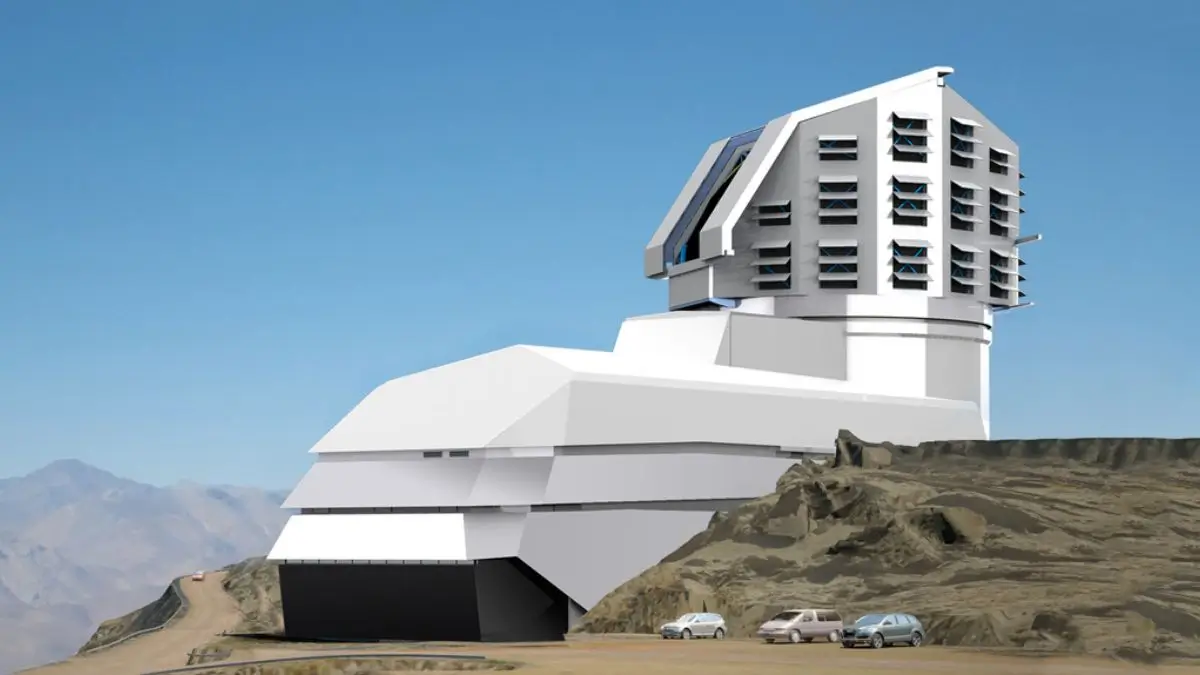
The NSF–DOE Vera C. Rubin Observatory in Chile has launched the its ambitious 10-year Legacy Survey of Space and Time (LSST). It marks the major milestone in modern astronomy. It is equipped with the world’s largest digital camera, this observatory will repeatedly scan the southern sky and producing an unprecedented time-lapse map of the Universe. This project is expected to transform understanding of the galaxies, dark matter, black holes, supernovae, and the evolution of the cosmos.
Rubin Observatory Starts Historic 10-Year LSST Mission
The Vera C. Rubin Observatory has begun the Legacy Survey of Space and Time (LSST),, it is a decade-long international scientific mission aimed at creating the most detailed map of the dynamic Universe ever produced.
It is located in Chile. This observatory combines the advanced telescope technology with a 3,200-megapixel digital camera, it is the largest ever built for astronomy.
It will capture a new image of the sky approximately in every 40 seconds and it allows scientists to monitor the changes across billions of celestial objects.
This project is jointly funded by the U.S. National Science Foundation (NSF) and the U.S. Department of Energy (DOE), and operations are to be managed by NSF NOIRLab.
Indian Scientists Play a Key Role
Indian researchers are actively participating in the international collaboration.
Professor Surhud More from the Inter-University Center for Astronomy and Astrophysics (IUCAA) has highlighted that this observatory will support research across a broad range of topics, including the,
- Solar System formation
- Exploding stars (Supernovae)
- Black holes
- Dark matter
- Evolution and future of the Universe
According to Prof. More, Rubin Observatory will provide valuable data for nearly every branch of observational astronomy.
Studying 20 Billion Galaxies
Professor Yogesh Wadadekar from the National Centre for Radio Astrophysics (NCRA-TIFR) has also emphasized that the survey will observe nearly 20 billion galaxies.
The enormous dataset will help the astronomers to study the,
- Galaxy formation and evolution
- Star formation history
- Cosmic structure
- Distribution of dark matter
- Large-scale evolution of the Universe
The mission is also expected to answer thousands of long-standing questions in astrophysics.
Discovering Thousands of Einstein’s Gravitational Lenses
One of the mission’s major scientific goals is to discover more than 10,000 gravitational lenses.
Gravitational lensing occurs when a massive object bends light from a distant galaxy or star, it is a phenomenon predicted by Albert Einstein’s General Theory of Relativity.
According to Dr. Anupreeta More, co-chair of the LSST Strong Lensing Science Collaboration, these discoveries will help the scientists to,
- Measure the expansion rate of the Universe
- Estimate the age of the Universe
- Observe rare cosmic explosions such as the supernovae and kilonovae
- Study dark matter distribution
This observatory is also expected to detect many gravitational lenses that have never observed before.
World’s Largest Digital Camera
The Rubin Observatory houses a 3,200-megapixel camera and it is the largest digital camera ever built for scientific observation.
Its capabilities includes the,
- Capturing one image every 40 seconds
- Scanning the entire southern sky every few nights
- Producing the ultra-high-definition time-lapse images of the Universe
The camera’s combination of high resolution and wide field of view makes it as one of the most advanced astronomical instruments that has ever been developed.
Massive Data Collection Every Night
Rubin Observatory will generate an enormous amount of scientific data.
Each night it is expected to produce the,
- Around 10 terabytes of astronomical data
- Nearly 7 million alerts about changes in celestial objects
These alerts will be processed by the automated systems known as alert brokers, enabling astronomers worldwide to rapidly identify the new discoveries and unusual cosmic events.
Named After Vera Rubin
The observatory is named after renowned American astronomer Vera C. Rubin, whose observations has provided the strongest early evidence for the existence of dark matter and it is one of the greatest mysteries in modern physics.
Her pioneering work has transformed our understanding of galaxy motion and it remains fundamental to cosmology today.
Key Facts
- Observatory: NSF–DOE Vera C. Rubin Observatory
- Location: Chile
- Mission: Legacy Survey of Space and Time (LSST)
- Mission Duration: 10 years
- Largest Camera: 3,200-megapixel digital camera
- Images Captured: One every 40 seconds
- Daily Data: About 10 TB
- Nightly Alerts: Up to 7 million
- Expected Gravitational Lenses: More than 10,000
- Indian Institutions: IUCAA and NCRA-TIFR
- Named After: Astronomer Vera C. Rubin








 Weekly Current Affairs One Liners (5th t...
 Weekly Current Affairs One Liners (28th ...
 Weekly Current Affairs One Liners (21st ...