
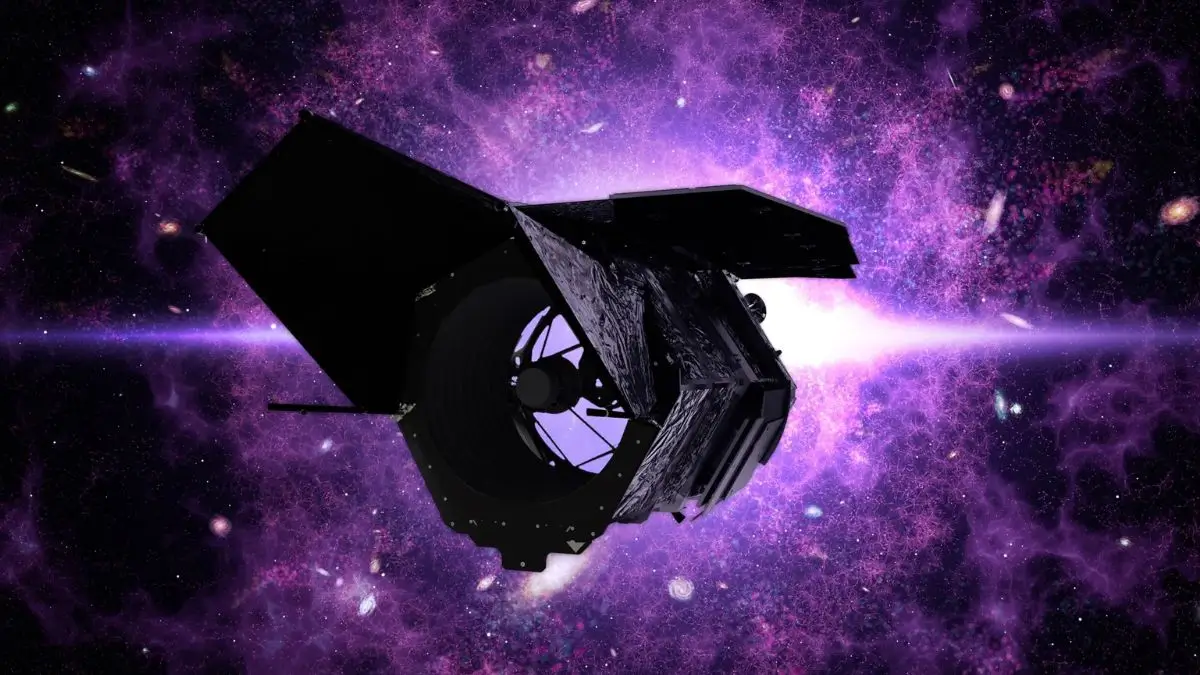
NASA has successfully completed the assembly of the Nancy Grace Roman Space Telescope at the Goddard Space Flight Center in the Maryland. It is often described as the next big thing after the Hubble Space Telescope and the James Webb Space Telescope. The Roman Telescope is now enters into the final testing phase ahead of its expected launch in 2026.
Final Assembly Marks The Major Milestone
The telescope has been fully assembled inside the high-tech cleanroom at NASA’s Goddard facility.
Engineers have integrated the spacecraft module, telescope optics, solar panels and the advanced scientific instruments into the single system.
This marks the transition from construction to final testing and launch preparation and it is one of the most important phases of the mission.
What Makes the Roman Telescope Unique
As compare to the its predecessors the Roman Telescope is designed for the wide-field sky surveys.
It is the 2.4-metre mirror is similar in size to Hubble and its capabilities are far more expansive.
Key highlights includes the,
- Ability to capture the images covering 100 times larger area than Hubble.
- Also the data collection will be1,000 times faster during survey operations.
- It also capability to scan the vast regions of space efficiently.
This will transform how the astronomers observe and understand the universe.
Repeated Sky Scans and Catching Cosmic Events
One of Roman’s most powerful features is the ability to repeatedly scan large areas of the sky.
This approach allows scientists to detect the short-lived cosmic events such as supernova which are often missed by traditional telescopes.
Researchers expect the thousands of such detections and helps to improve understanding of cosmic evolution.
Mission Goals: Dark Energy and Universe Expansion
A main objective of the Roman mission is to study dark energy and dark matter which together make up most of the universe but it remain poorly understood.
The telescope will map galaxies in the 3D and track their movement over time to understand why the universe is expanding at the accelerating rate.
This could provide the new insights into the fundamental structure and future of the cosmos.
Searching for Hidden Exoplanets
The Roman Telescope is also equipped with the coronagraph which is the specialized instrument.
This technology blocks the bright starlight and allows the scientists to detect faint nearby objects.
It can identify the exoplanets up to 100 million times dimmer than the host stars and specially gas giants similar to Jupiter.
Launch and Journey into Space
The Roman Telescope is expected to launch on aboard in the SpaceX Falcon Heavy rocket.
After the launch it will travel nearly 1 million miles from Earth to reach to the lagrange Point 2 (L2) which is a stable location in space ideal for deep-space observations.
Before the launch the telescope will undergo to the rigorous vibration and thermal tests to ensure it can withstand the harsh conditions of space.








 World Bank Ranks India Among Top 10 Emer...
 Elon Musk to Rename SpaceXAI as SpaceXSI
 Kerala Develops AI-Based Dengue Early Wa...










