
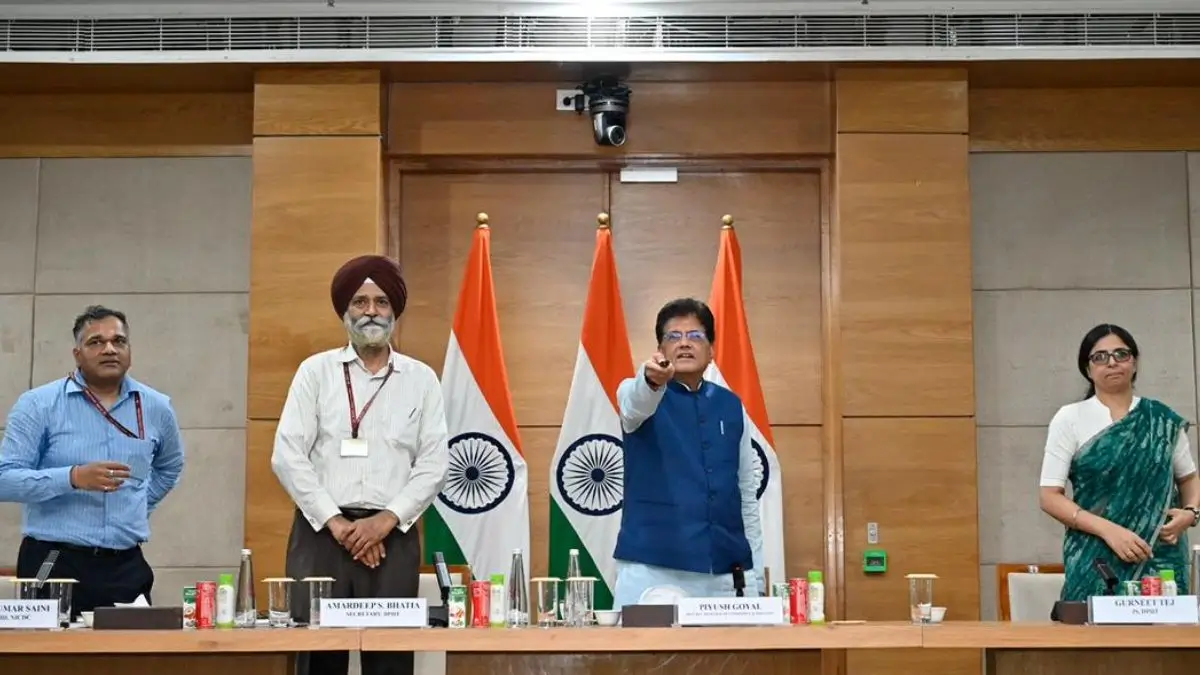
Respectable Union Commerce and Industry Minister Piyush Goyal has launched the BHAVYA Portal in New Delhi. This portal will implement the Bharat Audyogik Vikas Yojana (BHAVYA), it is a flagship scheme and it is aimed at to 100 world-class industrial parks across India. With the financial outlay of ₹33,660 crore this initiative seeks to accelerate the manufacturing growth, attract the domestic and foreign investments and generate the employment opportunities.
What is the BHAVYA Scheme?
The Bharat Audyogik Vikas Yojana (BHAVYA) is the Government of India’s flagship industrial infrastructure program that is designed to establish the 100 investment-ready industrial parks over the next six years.
This scheme focuses on to creating the integrated industrial ecosystems equipped with the modern infrastructure, multimodal connectivity, digital governance systems, worker-support facilities and sustainable development features.
The initiative also aims to provide the businesses with ready-to-use industrial spaces, reducing delays which are associated with land acquisition, approvals and the infrastructure development.
BHAVYA Portal: The Digital Platform for Industrial Development
The newly launched BHAVYA Portal will function as the single digital interface for the entire lifecycle of industrial park development under the scheme.
The portal will facilitate the,
- Submission of the Detailed Project Reports (DPRs)
- Project evaluation and appraisal
- Real-time monitoring of project implementation
- Stakeholder coordination
- Transparent selection of industrial park proposals
This platform has been developed by the National Industrial Corridor Development Corporation (NICDC), which has been designated as the Project Management Agency for the BHAVYA scheme.
Competitive Selection Model for States
The main key feature of the BHAVYA Scheme is its challenge-based competitive framework. All the States and Union Territories will be invited to submit the project proposals highlighting the,
- Availability of land
- Industrial strengths
- Sector-specific opportunities
- Investor demand
- Infrastructure readiness
The most promising proposals will be selected via a transparent evaluation process and will ensuring the efficient allocation of resources and better outcomes.
According to the government sources the proposals received between the June 1 and July 31, 2026 and it will be considered for the first batch of 20 industrial parks.
Infrastructure and Facilities Planned Under BHAVYA
The industrial parks developed under the BHAVYA will offers comprehensive infrastructure to support to business operations and its manufacturing activities.
Key facilities includes the,
- Assured power and water supply
- Road and rail connectivity
- Digital single-window clearances
- Reliable utility infrastructure
- Land title support
- Air connectivity where feasible
The government mainly intends to create the plug and play industrial ecosystems that enables the investors to start operations quickly and efficiently.
Special Focus on Startups, Deep-Tech and Innovation
The scheme goes beyond the just traditional manufacturing infrastructure by promoting the innovation-led growth.
Dedicated spaces may be developed for the,
- Startups
- Deep-tech companies
- Research and Development (R&D) centers
- Technology enterprises
- Innovation-driven businesses
This approach aligns with the India’s broader objective of fostering the knowledge-based economy and to strengthening its innovation ecosystem.
Modern Testing Facilities to Support Industries
To improve the product quality and export competitiveness the BHAVYA parks will include the advanced testing infrastructure.
The government plans to collaborate with several institutions such as,
- Bureau of Indian Standards (BIS)
- Export Inspection Agency (EIA)
- Food Safety and Standards Authority of India (FSSAI)
These facilities will help multiple industries for access certification and testing services within industrial parks and will reducing costs and turnaround time.
How Will BHAVYA Be Implemented?
Each industrial park will be developed through the Special Purpose Vehicle (SPV) under the Companies Act, 2013.
These SPVs will manage the areas like planning, development, investor support and long-term operations.
The National Industrial Corridor Development Corporation (NICDC) will act as the Project Management Agency (PMA).
Monitoring will include the,
- GIS-based tracking
- Audit systems
- Progress reporting
- Oversight by a National Steering Committee
This structure is designed to improve accountability and transparency.








 Who Is Navi Pillay? Nobel Peace Prize 20...
 Vande Bharat vs Amrit Bharat Express: Ke...
 Asian Games to LA28: Which Sports Earned...










