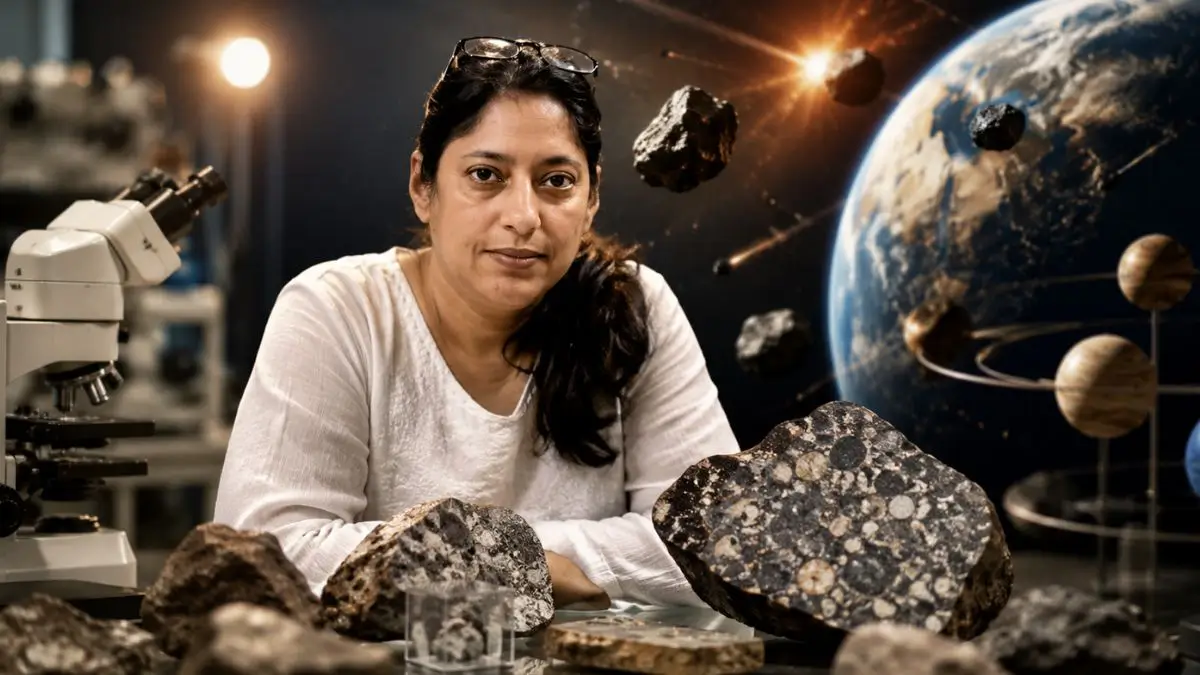
Prof. Kuljeet Kaur Marhas from Physical Research Laboratory in Ahmedabad has become the first Indian woman to be elected Fellow of the prestigious Meteoritical Society. Her recognition comes after decades of pioneering research into meteorites, isotopes and ancient planetary materials which reveals how solar systems was formed billions of years ago.
First Indian Woman Fellow of Meteoritical Society Kuljeet Kaur
Prof. Kuljeet Kaur Marhas was elected of the Meteoritical Society for 2026 and she joined a globally respected group of scientists which is known for exceptional contributions to meteoritics and planetary science.
It was founded in the year 1933 and it is among the world’s leading scientific organizations which are dedicated to the study of meteorites, planetary materials and the origins of the celestial bodies.
In the 93 year history, Prof. Marhas has become the first Indian woman to receive the honor and only the third Indian scientist elected as Fellow.
She is also one of the few Asian women recognized in this specialized field.
Earlier two Indian scientists honored by the society includes the,
- Devendra Lal
- JN Goswami
The Scientist Studying the Oldest Secrets of the Solar System
Prof. Marhas currently works at the Physical Research Laboratory in Ahmedabad which is India’s one of the leading centres for planetary and space science research.
Her research focuses on studying ancient extraterrestrial materials to understand how the Solar System was formed more than four billion years ago.
She is internationally known for her work on the,
- Short lived radionuclides
- Stable isotopes in meteorites
- Pre-solar grains
- Calcium Aluminum rich Inclusions (CAIs)
- Chondrules and organic matter in meteorites
These type of tiny materials preserved inside the meteorites which act like time capsules from the early Solar System and help the scientists to reconstruct planetary history.
Role of Advanced Technology For Research
One of the most important aspects of the Prof. Marhas’s work is the use of advanced scientific instruments such ast the,
- Secondary Ion Mass Spectrometry (SIMS)
- nanoSIMS technology
These technologies allows the scientists to study microscopic isotopic signatures inside the meteorites and space samples with the extraordinary precision.
Her research has also involved the analyzing samples from globally important space missions including,
- Stardust
- Hayabusa
- Apollo Program
Through these studies she has contributed significantly to understand the planetary evolution, early Solar System chemistry and cosmic material formation.
A Career Dedicated to Cosmochemistry and Space Research
Apart from the Meteoritical Society honor she is also a Fellow of the American Geophysical Union.
She has also received the prestigious Devendra Lal Memorial Medal.
Her contributions continue to influence the global research in cosmochemistry and planetary material analysis.
After getting recognition she stated that the achievement reflects the strong research environment at the Physical Research Laboratory and the growing potential of the planetary sciences in India.








 TRISHNA Satellite Mission 2027: ISRO-Fra...
 World Bank Ranks India Among Top 10 Emer...
 Elon Musk to Rename SpaceXAI as SpaceXSI