
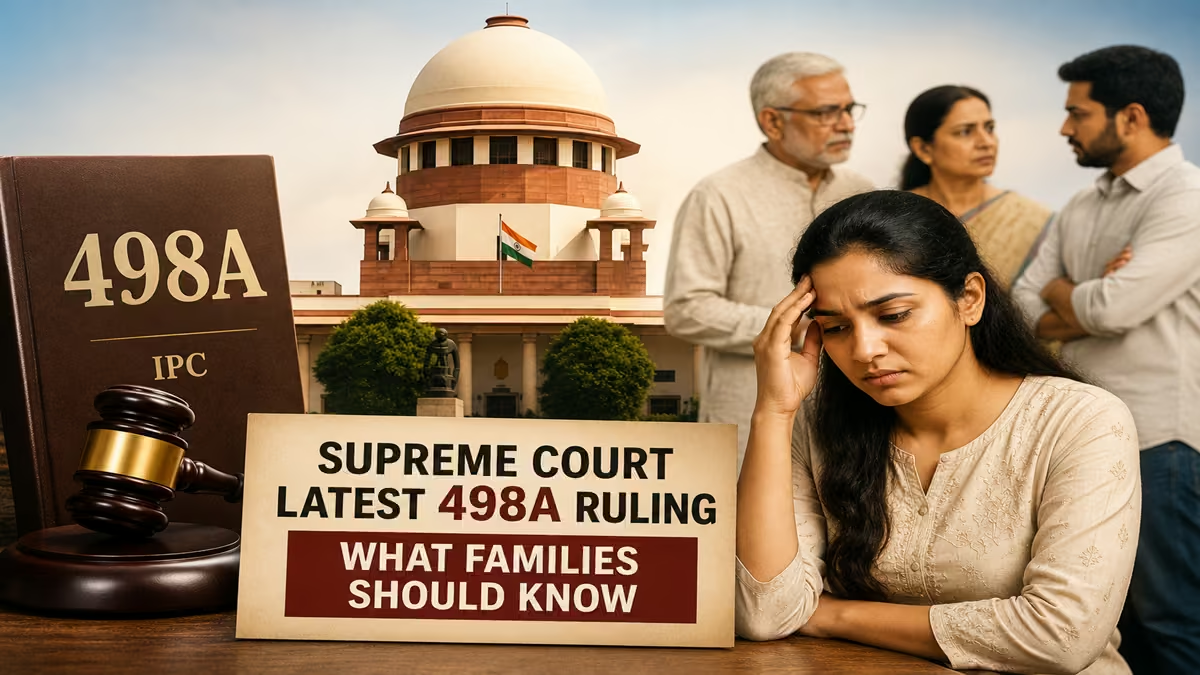
A recent Supreme Court judgment involving a dowry harassment case has once again brought attention to one of India’s most debated legal provisions — Section 498A of the Indian Penal Code.
In the latest ruling, the Supreme Court allowed criminal proceedings against the husband to continue but quashed the FIR against his family members, saying the allegations against the in-laws were too general and lacked specific evidence.
At first glance, this may look like just another court case. But the judgment highlights a much larger issue that affects thousands of Indian families every year:
How should courts balance protection for women with the risk of false implication of entire families?
To understand why this ruling matters, it’s important to first understand what Section 498A actually is.
What Is Section 498A?
Section 498A was introduced in 1983 to protect married women from cruelty, harassment, and dowry-related abuse by husbands or their relatives.
The law was created because dowry harassment and domestic abuse had become serious social problems in India. In many cases, women faced physical violence, emotional abuse, financial pressure, or threats related to dowry demands after marriage.
Under Section 498A:
- cruelty by a husband or his relatives is a criminal offence,
- police can register an FIR,
- and courts can initiate legal proceedings.
The law was designed to offer stronger legal protection to women facing abuse inside marriage.
Why This Law Has Been Debated for Years
While Section 498A remains an important legal safeguard, it has also been surrounded by controversy over the years.
One major concern raised by courts is that in some cases, complaints include not only the husband but almost every member of the husband’s family — including elderly parents, sisters, distant relatives, or family members living separately.
The Supreme Court has repeatedly observed that vague or exaggerated allegations without specific evidence can sometimes lead to misuse of the law.
This does not mean the law itself is wrong. It means courts are increasingly trying to ensure that criminal cases are supported by clear and individual allegations.
What Happened in the Latest Supreme Court Case?
In the recent matter, the woman had accused her husband and his family members of cruelty and dowry harassment.
After reviewing the case, the Supreme Court found:
- direct allegations existed against the husband,
- but the accusations against the in-laws were broad and lacked specific supporting details.
Because of this, the court decided:
- proceedings against the husband would continue,
- while the FIR against the relatives was quashed.
In simple terms, the court believed there was enough material to investigate the husband further, but not enough to continue criminal proceedings against the other family members.
Why Courts Are Becoming More Careful in Such Cases
Over the last decade, Indian courts have increasingly emphasized the need for:
- specific accusations,
- proper evidence,
- and individual accountability.
Judges have repeatedly stated that criminal law should not automatically involve every relative unless there is clear evidence of direct involvement.
This approach aims to prevent situations where:
- elderly parents,
- married sisters living elsewhere,
- or distant relatives
are unnecessarily dragged into long legal battles without sufficient proof.
The judiciary is trying to strike a balance between:
- protecting genuine victims,
- and preventing misuse of criminal provisions.
Does This Mean Dowry Harassment Is Not Serious?
Not at all.
Dowry harassment and domestic abuse remain major social problems in India.
Many women continue to face:
- emotional abuse,
- financial pressure,
- threats,
- physical violence,
- and coercion related to dowry demands.
For genuine victims, laws like Section 498A remain extremely important.
The court’s concern is not about weakening protection for women. The focus is on ensuring that criminal liability is based on evidence rather than general accusations.
Why This Judgment Matters for Ordinary Families
The latest ruling reflects an important shift in how courts are evaluating family-related criminal disputes.
For families, the judgment highlights several important lessons:
1. Courts Want Specific Evidence
General accusations against entire families may not be enough. Courts increasingly expect:
- dates,
- incidents,
- messages,
- financial records,
- or direct evidence.
2. Individual Responsibility Matters
Courts are moving away from the assumption that every relative is automatically involved in marital disputes.
3. Legal Cases Are Becoming More Evidence-Focused
Modern courts are placing greater emphasis on factual investigation instead of emotional assumptions alone.
4. Genuine Complaints Still Receive Protection
The ruling does not reduce the seriousness of domestic abuse or dowry harassment laws.
The Bigger Social Reality
The debate around Section 498A often becomes emotionally polarized.
Some people focus entirely on misuse concerns. Others focus entirely on protecting victims.
But the reality is more complex.
Both concerns can exist simultaneously:
- genuine victims need strong protection,
- and innocent individuals should not face criminal prosecution without evidence.
This is why courts are trying to create a more balanced legal approach.
What Families Should Understand Today
Marriage disputes involving criminal allegations can have long-term emotional, social, and financial consequences for everyone involved.
The latest Supreme Court ruling sends a broader message:
- allegations must be taken seriously,
- but criminal proceedings must also be supported by specific evidence.
For families, this highlights the importance of:
- documentation,
- communication,
- legal awareness,
- and careful handling of disputes.
Why Legal Awareness Is Becoming More Important
Many Indians still do not fully understand:
- matrimonial laws,
- criminal procedures,
- or family rights under Indian law.
As legal disputes become more common and social dynamics change, legal awareness is becoming increasingly important for ordinary families — not just lawyers.
Understanding how courts interpret laws can help people:
- make informed decisions,
- avoid panic,
- and approach disputes more responsibly.








 India’s Internet Subscribers Cross 1.1...
 JOSH Campaign Launched to Support Indiaâ...
 PM GatiShakti Completes Five Years: Obje...










