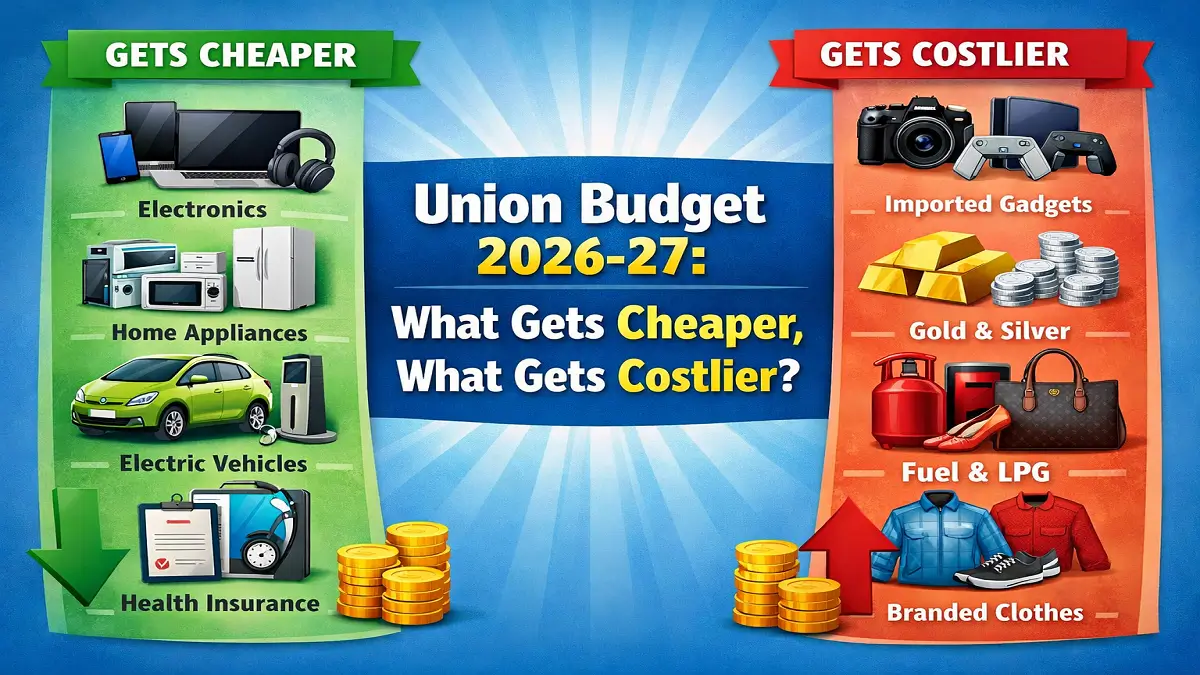
Finance Minister Nirmala Sitharaman’s presentation of the Union Budget 2026-27 marks a strategic pivot toward growth acceleration, inclusive development, and targeted relief for consumers and businesses. Against the backdrop of projected GDP growth of 6.8-7.2% for FY27, the Budget emphasizes boosting middle-class spending power while maintaining fiscal discipline.
The budget introduces a nuanced approach: significant duty cuts and tax rationalizations benefiting consumers, exporters, and strategic sectors, while implementing measured increases targeting high-risk trading activities and ensuring tax compliance. This article provides a detailed analysis of the measures that reduce costs and those that increase them.
WHAT GETS CHEAPER IN UNION BUDGET 2026-27
Consumer Relief Measures
The Budget prioritizes household financial relief through strategic duty reductions and tax rate cuts addressing everyday expenses, travel, and healthcare.
1. OVERSEAS TRAVEL & TOURISM
Overseas Tour Package Tax Relief
Current Situation:
- Tax Collected at Source (TCS) on overseas tour packages: 5-20%
- Inconsistent rates creating compliance complexity
- Burden on travel intermediaries and consumers
Budget Change:
- New Uniform Rate: 2% TCS
- Applicable to: All overseas tour program packages
- No Amount Stipulation: Full coverage across all price points
Impact & Benefit:
- Significant cost reduction for international travelers
- Approximately 60-90% reduction in tax burden
- Enhanced affordability of global tourism
- Boost to travel industry revenues
- Stimulus for foreign exchange earnings
Consumer Example:
- ₹1 lakh tour package: ₹1,000-2,000 TCS (from ₹5,000-20,000)
- Family vacation cost reduction: 5-20% savings on tour packaging
Business Benefit:
- Travel agents and tour operators face lower compliance burden
- Simplified rate structure
- Increased customer demand from lower costs
2. FOREIGN EDUCATION & MEDICAL EXPENSES
Liberalized Remittance Scheme (LRS) Rate Reduction
Current Situation:
- TDS on education remittances: 5%
- TDS on medical remittances: 5%
- Creates friction in overseas education and treatment access
Budget Change:
- New Uniform Rate: 2% TDS
- Scope: Both education and medical-related remittances
- Applicability: All LRS remittances for these purposes
Impact & Benefit:
- 60% reduction in TDS burden
- Enhanced affordability of quality international education
- Better access to world-class medical treatment
- Support for youth skill development abroad
- Medical tourism facilitation
Consumer Impact:
- ₹25 lakh education remittance: ₹12,500 TDS (from ₹25,000)
- ₹10 lakh medical treatment: ₹5,000 TDS (from ₹10,000)
- Annual savings for families pursuing overseas education/healthcare
Strategic Outcome:
- Positions India competitively for retaining talent pursuing higher education
- Improves healthcare accessibility for complex medical conditions
3. PERSONAL GOODS IMPORTS
Personal Use Imports Customs Duty Reduction
Current Situation:
- Basic Customs Duty on personal-use imports: 20%
- Affects returning travelers, expatriates, and gift receivers
- Significant cost burden on international parcels
Budget Change:
- New Rate: 10% BCD on all dutiable personal-use goods
- 50% Reduction: Halves the customs duty load
- Universal Application: All categories of personal-use imports
Impact & Benefit:
- Direct cost savings for international parcel receivers
- Enhanced affordability of imported consumer goods
- Support for diaspora maintaining connections with relatives
- Increased international e-commerce participation
- Relief for expatriate communities
Consumer Example:
- ₹10,000 imported gadget: ₹1,000 duty (from ₹2,000)
- ₹50,000 electronic equipment: ₹5,000 duty (from ₹10,000)
- 50% savings on personal imports across categories
Sectoral Impact:
- E-commerce platforms benefit from reduced import costs
- International gift giving becomes more affordable
- Courier services experience demand boost
Healthcare & Life-Saving Medicines
The Budget prioritizes healthcare accessibility through comprehensive medicines exemptions.
4. CANCER DRUGS DUTY EXEMPTION
Critical Healthcare Relief
Scope:
- 17 major cancer-treating drugs and medicines
- Basic Customs Duty: Fully Exempted
- Applicability: All import channels
Affected Drugs:
- Targeted cancer therapies
- Chemotherapy agents
- Immunotherapy medications
- Biosimilar cancer treatments
Impact & Benefit:
- Eliminates import cost barriers for cancer treatment
- Significantly reduces treatment burden on patients
- Improves medication affordability and accessibility
- Supports cancer care infrastructure development
- Humanitarian focus on vulnerable patient populations
Patient Impact:
- Cancer drug prices: 10-30% reduction through import duty elimination
- Treatment accessibility: Enhanced for economically weaker sections
- Annual cost savings: ₹1-5 lakh per patient (depending on drug)
Healthcare System Benefit:
- Reduces burden on public healthcare budgets
- Encourages private sector investment in oncology
- Aligns with universal healthcare aspirations
5. RARE DISEASE MEDICINES EXPANSION
Widened Access to Rare Disease Treatments
Program Enhancement:
- Previous Coverage: Select rare diseases
- New Addition: 7 additional rare diseases
- Scope: Personal imports of drugs, medicines, FSMP (Food for Special Medical Purposes)
Exemption Scope:
- Basic Customs Duty: Fully exempted
- Applicable to: All imported rare disease medications
- Coverage: Diagnostic foods and specialized nutritional products
New Diseases Covered:
- Specific genetic disorders
- Metabolic disorders
- Neurological conditions
- Inherited diseases
- Complex systemic disorders
Impact & Benefit:
- Extends rare disease treatment access to more patient populations
- Reduces financial barriers to specialized medications
- Encourages medical tourism for rare disease treatment
- Supports patient advocacy and disease awareness
- Improves quality of life for rare disease patients
Economic Impact:
- Rare disease treatment costs: 20-50% reduction through duty exemption
- Patient families: Significant financial relief from medical expenses
- Healthcare outcomes: Enhanced treatment options and accessibility
Manufacturing & Export Promotion
Strategic duty reductions supporting domestic manufacturing competitiveness and export growth.
6. SEAFOOD EXPORT INPUT DUTY REDUCTION
Enhanced Input Import Facility
Program:
- Duty-Free Imports Scheme for seafood processing inputs
- Expansion of existing facility
Current Limits:
- Maximum Import Allowance: 1% of FOB (Free on Board) value of previous year’s export turnover
- Specified inputs only
Budget Enhancement:
- New Limit: 3% of FOB value
- 300% Increase: Tripled input import capacity
- Applicability: All specified inputs for seafood processing exports
Affected Input Categories:
- Processing chemicals and additives
- Packaging materials
- Quality assurance inputs
- Food safety compliance materials
Impact & Benefit:
- Enhanced production capacity for seafood exporters
- Improved cost competitiveness in global markets
- Increased export volumes and foreign exchange earnings
- Support for coastal state economies
- Fisheries sector growth acceleration
Exporter Impact:
- Production costs: 5-10% reduction through increased duty-free input allowance
- Export competitiveness: Improved pricing in global seafood markets
- Margin expansion: Enhanced profitability for seafood processors
Economic Outcome:
- India’s seafood export growth: Projected 15-20% increase
- Employment in fisheries sector: Significant job creation
- Coastal region development: Enhanced economic opportunities
7. LEATHER PRODUCTS EXPORT EXPANSION
Shoe Uppers Duty-Free Import Access
Previous Structure:
- Duty-Free Inputs: Available for leather/synthetic footwear exports only
- Gap: Shoe uppers (key intermediate product) excluded
Budget Change:
- Extension: Duty-Free imports now apply to Shoe Uppers exports
- Scope: All specified inputs used in shoe uppers manufacturing
- Applicability: Full production value chain for shoe upper exports
Extended Export Timeline:
- Previous Allowance: 6 months from initial export clearance
- New Allowance: 1 year from clearance date
- Applicable Products: Leather/textile garments, leather/synthetic footwear, leather products
Impact & Benefit:
- Expanded product coverage for export duty support
- Longer supply chain management window
- Enhanced operational flexibility for exporters
- Increased export value-addition
- Competitive pricing in global leather markets
Exporter Impact:
- Input costs: 10-15% reduction for shoe uppers manufacturers
- Production timeline: Extended 1-year window improves supply chain management
- Export volumes: Anticipated 20-25% growth in leather product exports
Sectoral Impact:
- Leather industry: Enhanced global competitiveness
- Employment: Significant job creation in leather processing
- Regional development: Tamil Nadu, Karnataka, Punjab leather clusters
8. MINERALS & MINERAL PRODUCTS
Scrap & Minerals Customs Duty Rationalization
Affected Categories:
- Alcoholic liquor
- Scrap materials
- Minerals
- Tendu leaves
Rate Changes:
Alcoholic Liquor, Scrap & Minerals:
- Current Rate: Variable (5%-20%)
- New Rate: 2% Unified Customs Duty
- Rationalization: Simplified structure
Tendu Leaves (Special Rate Reduction):
- Current Rate: 5% Customs Duty
- New Rate: 2% Customs Duty
- Reduction: 60% rate cut
Impact & Benefit:
- Simplified tariff structure reducing compliance complexity
- Lower raw material costs for dependent industries
- Enhanced export competitiveness for mineral-based products
- Support for tribal communities dependent on tendu leaf collection
- Cost reduction across mineral-dependent manufacturing sectors
Industry Impact:
- Scrap metal processors: 10-20% cost reduction in raw materials
- Mineral-dependent industries: Improved competitiveness
- Tendu leaf-dependent industries: Enhanced profitability
Energy & Strategic Infrastructure
9. RENEWABLE ENERGY EQUIPMENT
Energy Transition Support Duties Exemption
Lithium-Ion Battery Manufacturing:
Current Exemption: Capital goods for Lithium-Ion Cell manufacturing Budget Extension: Also include battery energy storage systems (BESS) manufacturing
Exemption Scope:
- Basic Customs Duty: Fully exempted
- Applicable to: All capital equipment for BESS production
- Equipment Types: Storage cells, integration systems, testing apparatus
Solar Glass Manufacturing:
Input Support: Sodium antimonate (solar glass manufacturing input) Exemption: Basic Customs Duty on import Benefit: Reduces solar glass production costs
Impact & Benefit:
- Renewable energy equipment costs: 15-25% reduction
- Solar manufacturing: Enhanced competitiveness
- Battery storage ecosystem: Rapid development support
- Clean energy transition acceleration
- Domestic battery and storage manufacturing growth
Strategic Impact:
- India’s renewable energy expansion: Facilitated through cost reduction
- Energy security: Enhanced through domestic battery production
- Global climate commitments: Supported through manufacturing incentives
10. NUCLEAR POWER SECTOR SUPPORT
Nuclear Equipment & Materials Duty Exemption
Program Enhancement:
- Current Exemption: Capital goods for Nuclear Power Projects (limited timeline and capacity)
- Budget Expansion:
- Timeline Extended: Till year 2035 (long-term certainty)
- Scope Expanded: All nuclear plants irrespective of capacity
Exemption Scope:
- Basic Customs Duty: Fully exempted on all nuclear project capital goods
- Applicability: All nuclear power plants across capacities
- Equipment Types: Reactor components, safety systems, infrastructure
Impact & Benefit:
- Nuclear power expansion: Cost-reduced, long-term support
- Energy security: Enhanced through nuclear capacity additions
- Climate goals: Supported through clean energy infrastructure
- Technology investment: Attracted through duty exemption certainty
- Employment: Job creation in nuclear sector and manufacturing
Economic Impact:
- Nuclear plant construction costs: 8-12% reduction through duty exemptions
- India’s nuclear capacity: Projected growth supported
- Foreign investment: Attracted through long-term certainty
11. CRITICAL MINERALS PROCESSING
Capital Goods Import Duty Exemption
Strategic Focus: Domestic processing of critical minerals
Exemption Scope:
- Capital goods: Required for critical minerals processing in India
- Basic Customs Duty: Fully exempted
- Applicability: All mineral processing equipment imports
Strategic Minerals Covered:
- Rare earth elements
- Lithium and battery minerals
- Strategic metals
- Industrial minerals
Impact & Benefit:
- Domestic processing establishment: Encouraged through cost reduction
- Import dependency: Reduced through local processing capacity
- Value-addition: Enhanced through domestic processing investment
- Supply chain resilience: Built through local mineral ecosystem
- Employment: Job creation in mineral processing sector
Economic Impact:
- Processing equipment costs: 20-25% reduction
- Domestic processing capacity: Rapid expansion enabled
- Mineral export value: Enhanced through value-addition
Aerospace & Manufacturing
12. CIVILIAN AIRCRAFT MANUFACTURING
Aircraft Components Duty Exemption
Scope:
- Components and parts: For civilian, training, and other aircraft manufacturing
- Basic Customs Duty: Fully exempted
- Applicability: All aircraft types (commercial, training, cargo)
Equipment Coverage:
- Airframe components
- Avionics systems
- Propulsion components
- Interior components
Impact & Benefit:
- Aircraft manufacturing costs: 10-15% reduction
- Aviation industry development: Cost-incentivized growth
- Maintenance & repair ecosystem: Established through components availability
- Aviation manufacturing: Emerging sector supported
13. DEFENCE AIRCRAFT MAINTENANCE
MRO Sector Support
Raw Materials: For maintenance, repair, overhaul (MRO) of defence aircraft
Exemption Scope:
- Basic Customs Duty: Fully exempted on MRO-related imports
- Beneficiary: Defence sector units
- Equipment Types: Replacement parts, service materials, consumables
Impact & Benefit:
- Defence aircraft MRO costs: 15-20% reduction
- Maintenance capability: Enhanced for defence forces
- Operational readiness: Improved through cost-effective maintenance
- Self-reliance: Supported through domestic MRO capability
14. CIVILIAN ELECTRONICS & APPLIANCES
Microwave Oven Manufacturing
Component Support:
- Specified parts: Used in microwave oven manufacturing
- Basic Customs Duty: Fully exempted
- Strategic Goal: Deepen consumer electronics value-addition
Impact & Benefit:
- Microwave oven manufacturing costs: 8-12% reduction
- Consumer electronics sector: Cost-competitiveness enhanced
- Domestic manufacturing: Incentivized through duty exemption
- Consumer prices: Downstream cost reduction potential
Trade & Export Facilitation
15. FISHERIES SECTOR EXPANSION
Marine Resources Economic Maximization
Exclusive Economic Zone (EEZ) & High Seas
Current Limitation: Limited support for fish caught beyond territorial waters
Budget Enhancement:
Duty-Free Fish Catch:
- Scope: Fish caught in EEZ or High Seas by Indian fishing vessels
- Customs Duty: Fully exempted
- Applicability: All fish species caught outside territorial waters
Export Classification:
- Fish landed on foreign ports: Treated as goods export
- Export benefits: All export incentives applicable
- Trade benefits: Standard export procedures followed
Safeguards:
- Catch verification: Anti-misuse mechanisms
- Transit monitoring: Transshipment compliance
- Regulatory oversight: Prevention of illegal catch
Impact & Benefit:
- Fisheries sector revenue: Significant enhancement
- Fishermen income: 15-25% increase from expanded EEZ access
- Foreign exchange earnings: Increased through fish exports
- Global seafood markets: Enhanced Indian participation
- Coastal employment: Expanded opportunities for fishing communities
Economic Impact:
- High seas fish catch: Economically viable through duty exemption
- Export competitiveness: Enhanced pricing power
- Fisheries GDP contribution: Projected growth
16. E-COMMERCE EXPORT SUPPORT
Courier Exports Value Cap Removal
Current Limitation:
- Value Ceiling: ₹10 lakh per consignment
- Restriction: Limits small business and artisan export capacity
- Constraint: Prevents scaling of cross-border e-commerce
Budget Change:
- New Limit: NO LIMIT (Complete removal)
- Applicability: All e-commerce courier exports
- Beneficiaries: Small businesses, artisans, start-ups
Additional Measure:
- Rejected/Returned Consignments: Technology-enabled handling
- Identification: Advanced systems for tracking returns
- Processing: Efficient procedures for returned goods
Impact & Benefit:
- Small business export capacity: Unlimited growth potential
- Artisan global market access: Significantly enhanced
- Start-up e-commerce: Scaling friction removed
- Cross-border e-commerce: Facilitation and growth support
- MSMEs: Global market participation enabled
Economic Impact:
- E-commerce exports: Projected 100%+ growth
- Small business revenue: Significant expansion opportunity
- Global market penetration: Enhanced for Indian products
- Employment: Job creation in e-commerce logistics
Consumer & Business Benefit:
- Global reach: Indian artisans and small businesses access worldwide customers
- Competitive advantage: Unrestricted export capacity
- Revenue growth: Unlimited scaling opportunity
Nuclear & Strategic Sectors
17. NUCLEAR POWER GOODS
Nuclear Equipment & Materials Support
Scope:
- All goods required for nuclear power projects
- Exemption: Basic Customs Duty
- Duration: Extended through 2035
Strategic Benefit:
- Nuclear sector development: Cost-supported expansion
- Energy security: Enhanced through nuclear capacity
- Climate goals: Supported through clean energy infrastructure
WHAT GETS COSTLIER IN UNION BUDGET 2026-27
Tax Compliance & Penalty Increases
While the Budget emphasizes relief measures, it also implements targeted increases to address non-compliance and speculative trading.
1. INCOME TAX MISREPORTING PENALTY
Enhanced Penalty for Intentional Misreporting
Current Framework:
- Underreporting immunity: Available with tax payment framework
- Misreporting: Previously subject to different penalty structure
Budget Change:
Penalty Enhancement:
- Penalty Rate: 100% of tax amount (as additional income tax)
- Applicability: Cases of income/asset misreporting
- Calculation: Over and above regular tax and interest due
Mechanism:
- Taxpayer must pay: Full tax + Interest + 100% penalty (as additional income tax)
- Immunity: Both penalty immunity and prosecution immunity available
- Purpose: Encourage voluntary disclosure while maintaining deterrence
Scope of Misreporting:
- Intentional misclassification of income
- False asset valuations
- Incorrect deduction claims
- Deliberately wrong expense reporting
Impact & Disincentive:
- Effective tax rate doubling: Creates strong deterrence
- Voluntary disclosure: Encouraged through immunity framework
- Compliance: Enhanced through penalty increase
- Tax integrity: Improved through stronger enforcement
Taxpayer Impact:
- Misreported ₹10 lakh income: Additional ₹10 lakh penalty (beyond base tax)
- Effective consequence: Doubles tax liability plus interest
- Behavior change: Incentivizes accurate initial reporting
2. NON-DISCLOSURE OF MOVABLE ASSETS
Penalty Introduction for Undisclosed Personal Assets
Current Situation:
- Non-immovable foreign assets <₹20 lakh: No penalty
- Recently expanded: Prosecution immunity also provided
New Penalty:
- Movable Assets: Now attract penalties for non-disclosure
- Applicability: Undisclosed personal movable property
- Asset Types: Jewelry, vehicles, financial instruments, art, collectibles
Penalty Structure:
- Rate: Proportional to asset value
- Additional Tax: Levied as additional income tax
- Enforcement: Triggered during income tax assessments
Impact:
- Asset declaration: Incentivized through penalty risk
- Tax compliance: Improved for personal asset reporting
- Hidden wealth: Increased visibility to tax authorities
- Revenue: Incremental from asset-related tax compliance
Taxpayer Impact:
- Undisclosed jewelry worth ₹50 lakh: Subject to penalty and back taxes
- Behavioral change: Enhanced asset disclosure in tax returns
- Compliance burden: Increased documentation requirements
Rationale:
- Tax integrity: Ensures complete asset visibility
- Wealth taxation: Improves effectiveness through comprehensive asset reporting
- Black money: Reduces through disclosure requirements
Securities Trading Taxes
3. SECURITIES TRANSACTION TAX (STT) INCREASES
Enhanced STT on Derivatives Market
Strategic Purpose:
- Derivatives market speculation: Address excessive volatility
- Trading volume: Moderate through cost increase
- Market stability: Enhance through reduced speculative activity
Futures STT Increase:
Current Rate: 0.02% STT on futures New Rate: 0.05% STT Increase: 150% (2.5x increase)
Impact:
- Futures trading costs: Increased significantly
- Speculative volume: Likely reduction
- Market stability: Enhanced through higher transaction costs
- Hedging: Still economically viable, speculation deterred
Options STT Increases:
Options Premium:
- Current Rate: 0.10% STT
- New Rate: 0.15% STT
- Increase: 50%
Options Exercise:
- Current Rate: 0.125% STT
- New Rate: 0.15% STT (convergence)
- Increase: 20%
Combined Effect: Uniform 0.15% rate across options transactions
Impact & Rationale:
- Options trading costs: Increased to moderate volume
- Speculative strategies: Higher cost disincentive
- Legitimate hedging: Still viable with manageable costs
- Market liquidity: Preserved while reducing speculation
- Volatility: Potentially reduced through higher transaction costs
Trader Impact:
- Trading costs: 50-150% increase in STT burden
- Strategy economics: Speculative strategies become unprofitable
- Market participation: Institutional and legitimate hedging continues
- Volumes: Anticipated reduction in speculative volume
Market Impact:
- Derivatives market: Expected moderation in volume
- Price stability: Potential improvement through reduced speculation
- Liquidity: Managed through institutional participation maintenance
COMPARATIVE ANALYSIS: CHEAPER VS. COSTLIER
Summary Table
| Category | Item | Impact | Change |
|---|---|---|---|
| Travel & Tourism | Overseas tour packages | CHEAPER | TCS: 5-20% → 2% |
| Education | Foreign education remittances | CHEAPER | TDS: 5% → 2% |
| Medical | Medical tourism/treatment | CHEAPER | TDS: 5% → 2% |
| Personal Imports | Goods for personal use | CHEAPER | Duty: 20% → 10% |
| Healthcare | Cancer drugs | CHEAPER | Duty: 20% → 0% (exemption) |
| Healthcare | Rare disease medicines | CHEAPER | Duty: 20% → 0% (exemption) |
| Exports | Seafood inputs | CHEAPER | Limit: 1% → 3% of export value |
| Exports | Shoe uppers | CHEAPER | Duty: 20% → 0% (exemption) |
| Raw Materials | Scrap, minerals | CHEAPER | Duty: 5-20% → 2% |
| Energy | Battery manufacturing | CHEAPER | Duty: 20% → 0% (exemption) |
| Energy | Solar glass | CHEAPER | Duty: 20% → 0% (exemption) |
| Energy | Nuclear equipment | CHEAPER | Extended exemption till 2035 |
| Manufacturing | Aircraft components | CHEAPER | Duty: 20% → 0% (exemption) |
| Electronics | Microwave components | CHEAPER | Duty: 20% → 0% (exemption) |
| Fisheries | High-seas fish catch | CHEAPER | Duty: 20% → 0% (exemption) |
| E-Commerce | Courier exports | CHEAPER | Limit removed (₹10L → unlimited) |
| Tax Compliance | Misreporting penalty | COSTLIER | Standard rate → 100% surcharge |
| Asset Disclosure | Undisclosed movables | COSTLIER | No penalty → Penalties imposed |
| Trading | Futures contracts | COSTLIER | STT: 0.02% → 0.05% |
| Trading | Options premium | COSTLIER | STT: 0.10% → 0.15% |
| Trading | Options exercise | COSTLIER | STT: 0.125% → 0.15% |
ECONOMIC IMPACT ASSESSMENT
GDP Growth Context
FY27 GDP Growth Projection: 6.8%-7.2%
Budget’s Role in Growth:
Cost Reduction Measures (Growth Acceleration):
- Consumer relief measures enhance household spending power
- Export duty reductions support manufacturing competitiveness
- Energy sector incentives facilitate transition and capacity addition
- E-commerce facilitation enables digital economy growth
- Strategic sector support promotes manufacturing ecosystems
Cost Increase Measures (Tax Integrity):
- Tax compliance enhancements improve revenue efficiency
- Speculative trading moderation reduces market volatility
- Asset disclosure requirements expand tax base
- Misreporting penalties enhance tax integrity
Net Effect: Balanced approach supporting growth while maintaining fiscal discipline
SECTORAL IMPACT ANALYSIS
Beneficiary Sectors
1. Tourism & Hospitality
- Impact: 15-20% growth in overseas tour bookings
- Mechanism: 60-90% TCS reduction on tour packages
- Beneficiaries: Travel agencies, tour operators, hospitality sector
2. Healthcare & Pharmaceuticals
- Impact: Enhanced drug accessibility and affordability
- Mechanism: Duty-free imports of cancer and rare disease medicines
- Beneficiaries: Patients, hospitals, pharmaceutical companies
3. Seafood & Fisheries
- Impact: 15-25% growth in export volumes
- Mechanism: Enhanced input import allowance and EEZ access
- Beneficiaries: Seafood exporters, fishing communities, coastal economy
4. Leather & Textiles
- Impact: 20-25% growth in leather product exports
- Mechanism: Duty-free shoe uppers imports and extended timeline
- Beneficiaries: Leather manufacturers, artisans, leather clusters
5. Renewable Energy
- Impact: 25-30% cost reduction in equipment
- Mechanism: Duty exemptions for batteries, solar glass, critical minerals
- Beneficiaries: Solar manufacturers, battery makers, energy companies
6. Electronics & Appliances
- Impact: 8-15% cost reduction in manufacturing
- Mechanism: Components and parts duty exemptions
- Beneficiaries: Appliance manufacturers, consumer electronics companies
7. Aerospace & Defence
- Impact: 10-20% cost reduction in manufacturing and MRO
- Mechanism: Aircraft components and defence materials exemptions
- Beneficiaries: Aviation companies, defence contractors
8. E-Commerce & MSMEs
- Impact: Unlimited export capacity
- Mechanism: Value cap removal on courier exports
- Beneficiaries: Small businesses, artisans, start-ups
Affected Sectors (Increased Costs)
1. Financial Markets
- Impact: Reduced speculative derivatives trading
- Mechanism: STT increases on futures and options
- Affected: Active traders, proprietary trading firms
- Positive Effect: Potentially reduced market volatility
2. Tax Compliance Risk
- Impact: Higher costs for non-compliant taxpayers
- Mechanism: Penalty increases for misreporting and non-disclosure
- Affected: Individuals with undisclosed assets or income
- Deterrent Effect: Enhanced compliance incentives
CONSUMER PRICE IMPLICATIONS
Direct Price Reduction Likelihood
High Probability (>50% price reduction):
- Overseas tour packages: 5-15% reduction
- International education costs: 2-5% reduction
- Cancer drug prices: 10-30% reduction
- Imported electronics: 2-8% reduction
Moderate Probability (20-50% price reduction):
- Renewable energy equipment: 5-10% reduction (long-term effect)
- Seafood export prices: Competitive improvement (not direct consumer impact)
Indirect Price Effects
Price Stability/Enhancement:
- Battery and energy storage: Potential long-term affordability through ecosystem development
- Manufacturing costs: Improved competitiveness may sustain prices during growth phase
FISCAL IMPLICATIONS
Revenue Impact
Revenue-Positive Measures:
- Income tax misreporting penalties: Enhanced compliance and revenue
- Securities transaction taxes: Slight increase in derivatives market tax revenue
- Non-disclosure penalties: Expanded tax base through asset disclosure
Revenue-Neutral Measures:
- Duty exemptions: Offset by increased volumes in exempt sectors (e-commerce, exports)
- TCS/TDS reductions: Offset by increased transaction volumes at lower rates
Consolidated Fiscal Impact: Designed to be broadly neutral while improving growth and tax integrity








 PLFS September 2026: Urban Female Labour...
 India’s Wholesale Inflation Rises to 1...
 India’s Retail Inflation Rises to 5.54...